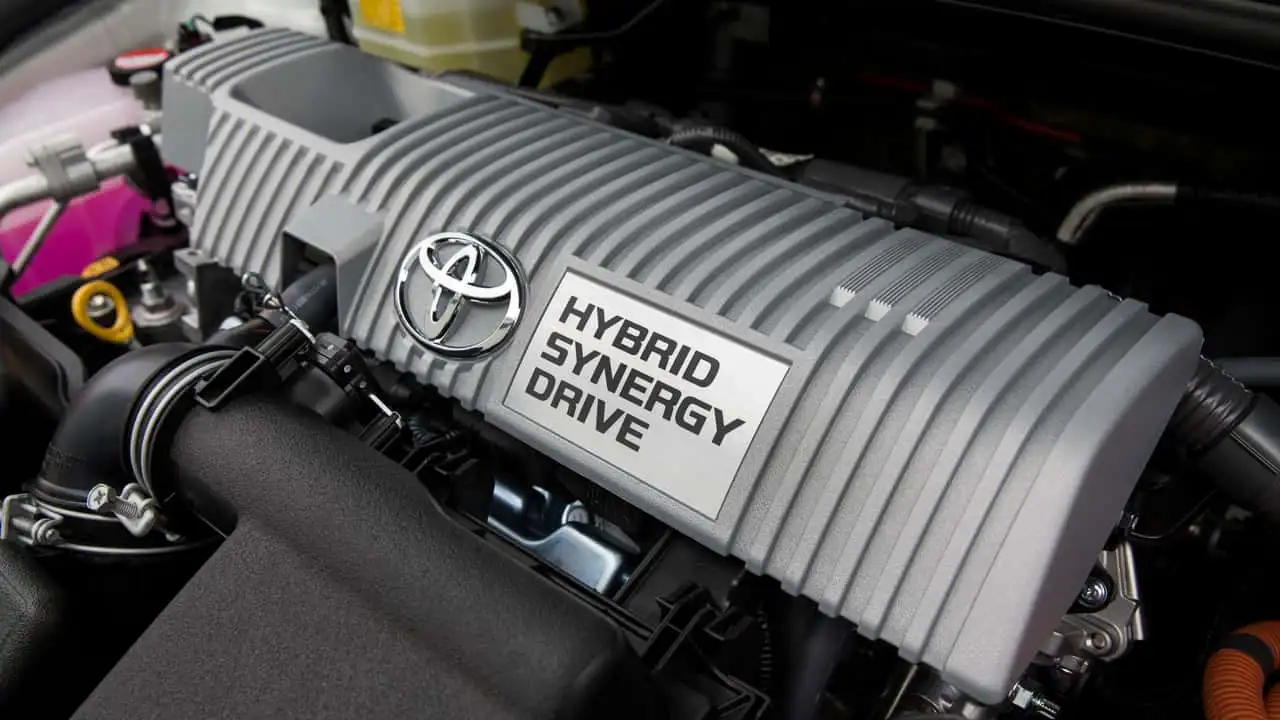
Toyota has spent nearly three decades building its reputation around hybrid vehicles.
The original Prius helped make hybrid technology mainstream, and Toyota has continued to sell millions of hybrid cars around the world.
Now, the company is preparing another major step in its hybrid strategy.
Toyota plans to begin converting battery production lines in Japan to produce a new generation of batteries for hybrid vehicles from 2027, with the initial production capacity expected to be enough for approximately 600,000 vehicles per year.
Toyota says the new batteries are being developed to improve hybrid performance while also reducing production costs.
That could eventually mean more efficient Toyota and Lexus hybrids without requiring larger battery packs.
But there is an important detail here.
Toyota has not yet revealed all of the technical specifications or chemistry of these new hybrid batteries.
So while the potential is significant, some of the more specific claims circulating online should be treated carefully.
Toyota isn’t giving up on hybrids
The announcement comes at an interesting time for the automotive industry.
Many manufacturers are investing heavily in fully electric vehicles.
Toyota, however, has continued to argue that different markets need different electrified powertrains.
Its strategy includes:
- Hybrid electric vehicles
- Plug-in hybrids
- Battery-electric vehicles
- Hydrogen fuel-cell vehicles
Hybrids remain particularly important to Toyota.
Recent reporting indicates that Toyota expects global hybrid sales to exceed 5 million vehicles in 2026, potentially marking the first time the company reaches that level.
That makes improving hybrid technology a major business priority.
Why does the battery matter so much in a hybrid?
A hybrid may still have a petrol engine, but its battery plays an important role in determining how efficiently the vehicle operates.
The battery stores electricity generated through regenerative braking and, depending on the system, from the engine.
That stored electricity can then be used to power an electric motor.
Instead of relying entirely on the petrol engine, the vehicle can combine electric propulsion and combustion power depending on the driving conditions.
The result can be significantly lower fuel consumption than a comparable conventional vehicle.
Toyota wants to make that system better
The company’s new generation of hybrid batteries is intended to improve the performance and efficiency of that system.
Toyota has said its new-generation hybrid batteries will offer improved performance at a lower production cost.
That could translate into several benefits.
A more capable battery could potentially allow the vehicle to use electric propulsion more effectively.
It could also help the hybrid system recover and deploy energy more efficiently.
And if the battery costs less to manufacture, Toyota could potentially reduce the cost of producing future hybrid vehicles.
But don’t expect a huge electric-only range
This is where hybrid batteries are different from EV batteries.
A conventional hybrid doesn’t need a massive battery.
The vehicle still has a petrol engine.
Instead, the battery is designed to work repeatedly with the electric motor and regenerative-braking system.
That means Toyota’s goal isn’t necessarily to give a hybrid hundreds of kilometres of electric-only driving.
It’s about making the entire powertrain more efficient.
Regenerative braking is a key part of the equation
One of the cleverest aspects of a hybrid is its ability to recover energy that would otherwise be wasted during braking.
In a conventional car, much of the vehicle’s kinetic energy is converted into heat through the brakes.
A hybrid can instead use the electric motor as a generator.
As the vehicle slows, energy is recovered and stored in the battery.
That electricity can later be used to help propel the car.
The better the system becomes at managing that energy, the greater the potential efficiency benefit.
A better battery can make this cycle more effective
The battery needs to accept energy during regenerative braking and deliver energy when the electric motor needs it.
That means hybrid batteries experience a different operating pattern from many EV batteries.
They can undergo frequent charge and discharge events.
A next-generation battery designed specifically for this application could potentially improve how efficiently those energy flows are managed.
Toyota has decades of hybrid battery experience
This is one area where Toyota has an advantage.
The company has been developing and manufacturing hybrid systems since the 1990s.
Toyota’s hybrid battery technology has evolved significantly since the first-generation Prius.
For many years, Toyota relied heavily on nickel-metal hydride (NiMH) batteries in its hybrid vehicles.
More recently, the company has increasingly adopted lithium-ion batteries in newer models.
The newer RAV4, for example, has moved to lithium-ion technology.
NiMH isn’t simply obsolete
It’s worth making this distinction.
Nickel-metal hydride batteries have been extremely important to Toyota’s hybrid success.
They are known for their durability and have been used successfully in millions of vehicles.
The shift toward lithium-ion isn’t necessarily because NiMH suddenly became a bad technology.
Rather, lithium-ion technology has continued to improve in areas such as energy density and packaging.
That makes it increasingly attractive for modern hybrid applications.
What exactly is Toyota changing?
This is one area where Toyota has been relatively cautious.
The company has confirmed that it is preparing next-generation batteries for hybrids, but it has not provided all the technical details about the chemistry and architecture of those batteries.
Recent reporting has therefore been careful to describe them simply as next-generation hybrid batteries rather than assuming they will use one particular chemistry.
That matters because it is easy for headlines to turn a developing battery programme into a much more specific claim than Toyota itself has made.
Production is expected to begin ramping up in 2027
Toyota plans to convert existing battery production capacity in Japan during 2027 and 2028.
The initial capacity is expected to be sufficient for batteries used in approximately 600,000 hybrid vehicles annually.
Toyota is also considering expanding production capacity as demand grows.
That suggests the company expects hybrids to remain an important part of its global sales strategy for years to come.
Why 600,000 vehicles matters
Six hundred thousand battery-equipped vehicles is not a small pilot project.
It represents substantial manufacturing capacity.
If Toyota eventually expands that capacity, the technology could spread across a large number of Toyota and Lexus models.
The company doesn’t necessarily need to put the batteries into one specific vehicle.
A scalable battery technology could potentially be adapted across different hybrid platforms.
The Lexus connection
Toyota’s hybrid strategy isn’t limited to Toyota-branded vehicles.
Lexus also relies heavily on electrified powertrains.
That means improvements in battery technology could eventually find their way into premium Lexus hybrids as well.
For Lexus, better battery technology could be used not only to improve efficiency but also to support smoother and more responsive driving characteristics.
Lower production costs could be just as important as efficiency
This part of Toyota’s announcement deserves more attention.
Battery technology is often discussed in terms of range and performance.
But manufacturing cost is just as important.
If Toyota can produce a battery with better performance while spending less to manufacture it, the company has more flexibility.
It could:
- Reduce vehicle production costs
- Improve margins
- Offer more technology at similar prices
- Make hybrids more competitive
- Invest the savings elsewhere
Toyota has not said that consumers will automatically see the entire cost reduction in vehicle prices.
So we shouldn’t assume cheaper batteries will immediately mean cheaper cars.
The hybrid advantage is different from the EV advantage
An EV needs a large battery because its battery is its primary energy source.
A conventional hybrid doesn’t.
Instead, the battery works alongside the petrol engine.
That means even relatively small improvements in battery efficiency can have an impact on the overall vehicle.
A more capable hybrid battery can allow the electric motor to contribute more effectively.
That can reduce how often the petrol engine has to do all the work.
City driving could benefit particularly strongly
Hybrid vehicles are especially well suited to stop-and-go traffic.
There are frequent opportunities for regenerative braking.
The vehicle can repeatedly recover energy and then use that energy when accelerating again.
A conventional petrol vehicle loses much of that braking energy as heat.
A hybrid can capture some of it.
That’s one reason Toyota hybrids have become particularly popular in urban environments.
What happens during acceleration?
When a hybrid accelerates, the electric motor can assist the petrol engine.
The battery provides the electrical energy needed by the motor.
This allows the engine to operate more efficiently in certain situations.
The exact behaviour varies by Toyota’s hybrid system and vehicle.
But the fundamental principle is the same:
Use the electric motor when it makes sense and the engine when it makes sense.
The battery doesn’t need to be huge
This is another advantage.
A hybrid battery doesn’t need to store enough electricity to drive the vehicle hundreds of kilometres.
It needs enough energy to repeatedly assist the powertrain.
That can keep the battery relatively compact compared with a full EV battery pack.
And because the battery is smaller, the vehicle doesn’t have to carry hundreds of kilograms of additional battery capacity simply to provide electric range.
This could help Toyota’s fuel economy targets
The ultimate goal is not simply to sell cars with new batteries.
It’s to improve the efficiency of the vehicle.
If the battery and electric motor can handle a larger share of the vehicle’s energy demands, the petrol engine may consume less fuel.
Over thousands of kilometres, even relatively small improvements in fuel economy can add up.
For drivers, that means fewer trips to the fuel station and potentially lower running costs.
But there are limits
A hybrid is still carrying an internal-combustion engine.
It still burns petrol.
It still produces tailpipe emissions.
It isn’t equivalent to a battery-electric vehicle.
Toyota’s approach is therefore based on improving efficiency rather than eliminating combustion altogether.
That distinction is important when comparing the environmental performance of hybrids and EVs.
Toyota’s strategy is broader than hybrids
While the company is investing heavily in hybrid batteries, Toyota hasn’t abandoned EV battery development.
In fact, Toyota has a separate roadmap for next-generation batteries intended for battery-electric vehicles.
The company has previously announced several battery technologies for BEVs, including a lower-cost bipolar LFP battery targeting a 20% increase in cruising range and a 40% reduction in cost compared with the then-current bZ4X benchmark.
That is a separate programme from the newly announced hybrid battery production plans.
Toyota’s BEV roadmap is more ambitious
Toyota has also outlined a high-performance lithium-ion battery intended for future EVs.
The company has said that this battery could help enable vehicles with around 1,000 km of cruising range when combined with vehicle-efficiency improvements such as better aerodynamics and lower weight.
Toyota has also been developing solid-state batteries, with a target of commercialisation around 2027–2028, although bringing that technology into large-scale production remains a major engineering challenge.
Why Toyota needs several battery technologies
There is no single battery that is perfect for every application.
A battery designed for a hybrid has different requirements from one designed for a long-range EV.
A hybrid needs:
- Frequent charge/discharge cycles
- Strong power delivery
- Compact packaging
- Durability
- Competitive cost
An EV needs:
- High energy density
- Large energy capacity
- Fast charging
- Long cycle life
- Thermal stability
Toyota’s multi-technology approach reflects those different requirements.
This is also about keeping hybrids competitive
Toyota has made it clear that it believes hybrids will remain important in markets where EV adoption is constrained by factors such as charging infrastructure, vehicle prices and consumer preferences.
That argument is particularly relevant in developing markets.
In countries where public charging networks are still limited, a hybrid can provide some of the efficiency benefits of electrification without requiring the driver to depend entirely on charging infrastructure.
Why this matters in Africa
This could make Toyota’s next-generation hybrid technology particularly relevant to African markets.
EV adoption is growing, but charging infrastructure remains uneven across many countries.
A conventional hybrid doesn’t need a charging station.
It can refuel like a normal petrol vehicle while using its battery and electric motor to reduce fuel consumption.
For drivers who want to reduce petrol use but aren’t ready to depend entirely on public charging infrastructure, that can be an attractive middle ground.
Nigeria could be an interesting market
Nigeria is already familiar with Toyota hybrids, although their availability and pricing vary by model and importer.
For Nigerian drivers, the biggest potential advantage of more efficient hybrid technology is straightforward:
less petrol consumption.
That matters in a market where fuel costs can have a significant effect on household and business transportation budgets.
However, the eventual benefit will depend on which Toyota models receive the new battery technology and when those models become available in Nigeria.
Don’t expect every Toyota hybrid to change overnight
Toyota isn’t replacing every hybrid battery immediately.
The transition is expected to happen progressively as production lines are converted and manufacturing capacity increases.
The initial 600,000-vehicle capacity is only the starting point. Toyota is considering additional capacity as demand grows.
So it could take several years before the technology becomes widespread across Toyota’s global hybrid lineup.
What could drivers actually notice?
If Toyota achieves its goals, the improvements may not be dramatic in one single area.
Instead, drivers could experience a collection of small improvements:
- Better fuel economy
- Smoother transitions between engine and electric power
- More effective regenerative braking
- Improved electric-motor assistance
- Potentially better acceleration response
- Lower battery production costs
Together, those improvements could make the hybrid system more effective.
The biggest unknown is still the battery chemistry
This is something GoGreenway readers should watch.
Toyota has not publicly provided enough information to conclude exactly what chemistry will be used across its new hybrid battery generation.
Reports have speculated about lithium-ion technology, particularly given Toyota’s broader transition away from NiMH in newer applications.
But until Toyota provides complete technical specifications, it is better to describe the technology as a next-generation hybrid battery system rather than make a definitive chemistry claim.
This is evolution rather than revolution
Toyota’s new hybrid battery isn’t likely to suddenly transform a hybrid into an EV.
That’s not the objective.
The more realistic expectation is incremental improvement.
Better battery technology can help Toyota squeeze more efficiency out of a powertrain it has already spent decades refining.
And when you’re producing millions of vehicles, even a relatively small improvement can have a substantial cumulative effect.
The bigger picture
Toyota’s strategy highlights something important about the transition away from conventional petrol cars.
Electrification doesn’t have to happen in exactly the same way everywhere.
For some drivers, a battery-electric vehicle makes perfect sense.
For others, a hybrid may be more practical.
For still others, a plug-in hybrid could provide a useful compromise.
The best solution depends on infrastructure, vehicle cost, driving patterns and local energy conditions.
GoGreenway verdict
Toyota’s next-generation hybrid batteries could be an important development, particularly because the company already sells hybrids at enormous scale.
The planned transition of Japanese battery production lines from 2027, with initial capacity for around 600,000 hybrid vehicles annually, shows that Toyota is treating the technology as more than a laboratory experiment.
The potential benefits are attractive:
Better efficiency.
Lower production costs.
More effective electric assistance.
Potentially lower fuel consumption.
But we should be careful about promising specific improvements before Toyota releases more technical details.
The company’s separate BEV battery roadmap does include a previously announced 20% range improvement for its LFP-based “popularisation” battery, but that should not be confused with the newly announced hybrid battery programme.
For now, the most interesting thing about Toyota’s announcement is not a particular range figure.
It’s the fact that the world’s biggest hybrid manufacturer is continuing to invest heavily in improving the technology that made its name.
The next generation of Toyota hybrids may not look radically different. But underneath, they could become considerably smarter and more efficient.
Sources
- Toyota Global — Electrified Technologies and Battery Roadmap
- Toyota Integrated Report — Next-generation battery development
- Toyota Media Site — Advanced battery technology roadmap
- Motor1 — reporting on Toyota’s 2027 hybrid battery production plans
- InsideEVs — reporting on Toyota’s next-generation hybrid batteries