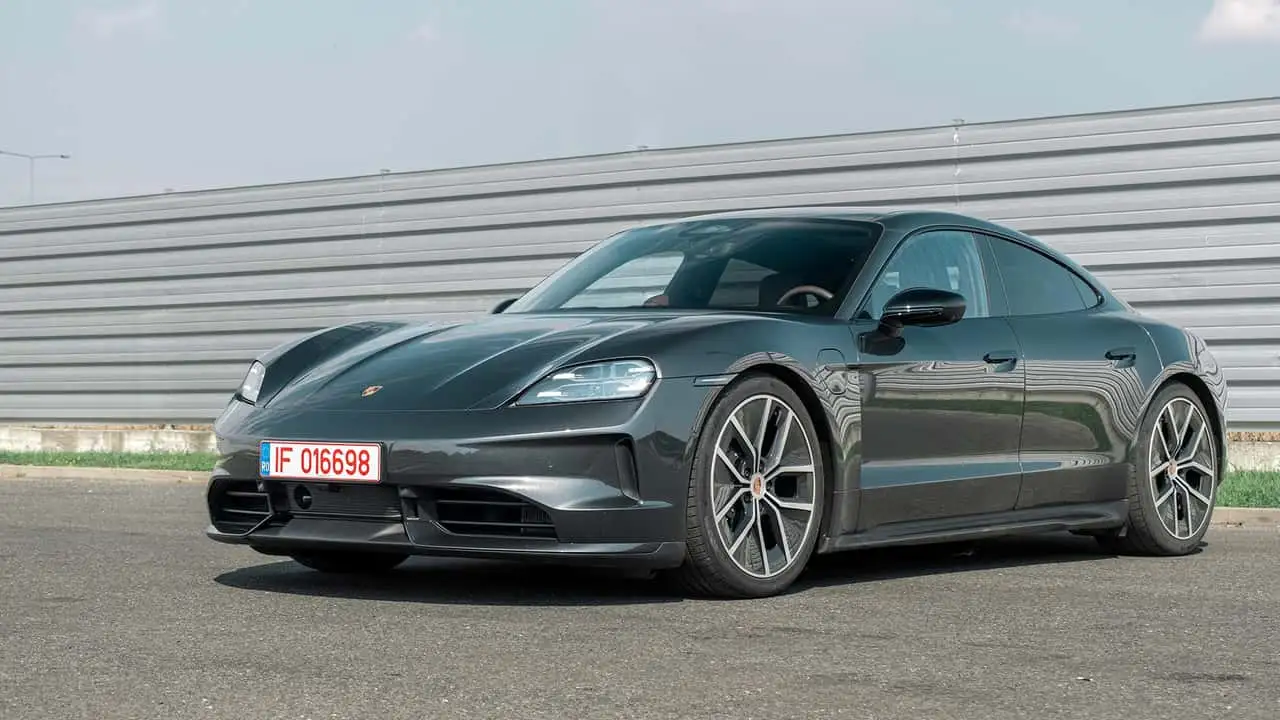
The Porsche Taycan was supposed to prove that a high-performance electric car could live up to the standards of one of the world’s most famous sports-car brands.
When Porsche launched the Taycan in 2019, it represented a major shift for the company. Porsche was no longer simply experimenting with electric vehicles — it was putting its reputation behind a fully electric sports sedan.
Now, less than a decade later, the Taycan’s future is reportedly uncertain.
A report from German business magazine WirtschaftsWoche, cited by Reuters and several other automotive publications, says Porsche is planning to end Taycan production by 2030. The report also says an earlier plan to move production from Porsche’s Stuttgart-Zuffenhausen plant to Leipzig has been abandoned.
There is an important caveat, however.
Porsche has not officially confirmed that the Taycan will end production in 2030.
A Porsche spokesperson declined to comment directly on the report, instead referring Reuters to CEO Michael Leiters’ July interview with Frankfurter Allgemeine Zeitung, in which he said there were no plans to discontinue the Taycan in the short term.
So this isn’t yet an official farewell.
But the circumstances surrounding the Taycan make the report difficult to ignore.
The car that introduced Porsche to the EV era
The Taycan was launched in 2019 as Porsche’s first fully electric production model.
At the time, it was an important statement.
Porsche wanted to show that an EV didn’t have to be a quiet, efficiency-focused family car.
It could be fast.
It could handle.
It could feel like a Porsche.
The Taycan quickly became one of the most important electric performance cars on the market.
It also helped establish the idea that electric propulsion could deliver the kind of instant acceleration and repeatable performance associated with Porsche’s combustion-powered sports cars.
For a company with such a strong connection to the internal-combustion engine, the Taycan represented a significant technological and cultural shift.
But Taycan sales have fallen sharply
The biggest problem is demand.
According to German broadcaster SWR, Taycan sales rose to almost 41,000 units in 2023, but fell to roughly 16,000 in 2025. In the first half of 2026, Porsche delivered only around 6,700 Taycans worldwide.
That is a dramatic change.
The Taycan had once been a major part of Porsche’s electrification story.
Now its sales are much smaller.
And that matters because Porsche operates in the premium and luxury segments, where relatively low production volumes can make sense — but only when customers are willing to pay premium prices.
Weak demand makes maintaining dedicated production capacity much harder to justify.
Porsche reportedly considered moving production
The reported 2030 plan isn’t the first sign that Porsche has been reconsidering the Taycan’s future.
According to WirtschaftsWoche, Porsche had previously considered moving Taycan production from its main Stuttgart-Zuffenhausen facility to its Leipzig plant. That option has reportedly now been abandoned.
Another possibility reportedly considered was ending production much sooner.
Instead, the reported agreement would keep the Taycan in production until the end of the decade.
If accurate, that would represent a gradual withdrawal rather than a sudden cancellation.
Porsche hasn’t abandoned the Taycan yet
This is where the story becomes more complicated.
Porsche continues to invest in the Taycan.
In June 2026, the company announced a new model-year update featuring an optional E-Shift system with virtual gear changes, an updated Electric Sport Sound and a new-generation infotainment system with AI-powered voice control.
That doesn’t look like a company that has completely given up on the model.
But it could also be interpreted differently.
A manufacturer can continue improving a vehicle even when it has decided that the current generation will eventually be phased out.
The 2026 updates therefore don’t necessarily disprove the report.
They simply demonstrate that the Taycan remains part of Porsche’s current product strategy.
The Taycan isn’t Porsche’s only electric car anymore
The situation was very different when the Taycan launched.
At the time, it was Porsche’s flagship electric experiment.
Today, it has company.
The Macan Electric has become a major part of Porsche’s EV strategy.
Porsche’s first-half 2026 figures show that the company delivered 15,620 Macan Electric vehicles during the period, compared with roughly 6,700 Taycans.
That is significant.
It suggests that Porsche’s electric future may be shifting away from the Taycan-style luxury sports sedan toward electric SUVs and other body styles that have broader market appeal.
The Macan Electric is changing the equation
SUVs have become increasingly important to Porsche’s business.
The conventional Macan remains one of the company’s biggest-volume models, and the electric Macan gives Porsche an opportunity to transition that successful nameplate into the EV era.
That could be more commercially important than simply selling more Taycans.
The Taycan competes in a relatively specialised segment.
The Macan sits in the enormously popular luxury SUV market.
For Porsche, that distinction matters.
An electric SUV can potentially attract buyers who want an EV but still need space, practicality and a higher seating position.
The Taycan is a very different proposition.
Porsche is no longer betting everything on a rapid EV transition
The Taycan’s reported future also needs to be viewed against Porsche’s broader strategic change.
The company had previously set an ambitious target of having more than 80% of its vehicle deliveries be fully electric by 2030, depending on market conditions and customer demand. Porsche’s earlier reporting explicitly tied that target to how quickly electric mobility developed in different markets.
But the EV market has not developed at the pace many manufacturers expected.
Porsche has therefore been extending its commitment to combustion engines and hybrid vehicles alongside EVs.
That means the company is effectively pursuing three technologies:
Petrol engines + hybrids + fully electric vehicles.
For a sports-car manufacturer, that flexibility may be becoming increasingly important.
China has made the problem worse
Porsche’s difficulties aren’t limited to the Taycan.
The company is also facing major challenges in China.
Reuters reported in July that Porsche planned to cut another 5,000 jobs, bringing planned workforce reductions to around 9,000 by 2035. The company is dealing with declining Chinese sales, slower-than-expected EV adoption and increasing competition from Chinese manufacturers.
China is particularly important because it has become one of the world’s most competitive EV markets.
Chinese manufacturers have moved quickly in battery technology, software, vehicle pricing and electric powertrains.
That puts European luxury manufacturers under pressure.
Porsche is competing not only against traditional luxury brands, but increasingly against sophisticated Chinese EV companies.
The Taycan’s problem isn’t that it is a bad car
This distinction is important.
The reported decline in Taycan demand does not necessarily mean the vehicle failed technologically.
Quite the opposite.
The Taycan demonstrated that an electric car could deliver exceptional performance.
Its 800-volt electrical architecture was ahead of many competitors when the car launched.
Its charging capabilities remain impressive.
And Porsche has continued updating the vehicle.
The problem is more fundamental:
Consumers aren’t buying enough of them.
A technically excellent product can still struggle commercially.
The luxury EV market is changing
The Taycan also arrived during a period when luxury buyers were increasingly interested in electric vehicles.
But the market has matured.
Customers now have more choices.
They can buy electric SUVs, crossovers, sedans and performance cars from Porsche, Mercedes-Benz, BMW, Audi, Tesla, Lucid and an expanding number of Chinese manufacturers.
That makes the Taycan’s position more difficult.
A buyer looking for an expensive EV no longer has to choose between a handful of products.
There are now many alternatives.
The Taycan also faces an unusual body-style problem
The global car market has moved heavily toward SUVs.
That shift has affected almost every traditional sedan.
The Taycan is fundamentally a low-slung performance car.
Even though Porsche has offered multiple body styles, including the Sport Turismo and Cross Turismo, the model’s identity remains closely tied to the sports sedan.
The Macan Electric, meanwhile, sits in a much larger and more popular segment.
That doesn’t mean Porsche should never build electric sports cars.
It means the company may be more cautious about dedicating major production resources to one.
What happens after the Taycan?
This is perhaps the most interesting question.
If Porsche eventually ends Taycan production, that doesn’t necessarily mean the company will abandon electric performance cars.
The company could instead integrate the Taycan’s technology into future generations of other models.
There have also been reports that future Porsche electric models could share technology across different product lines.
The company’s broader strategy is likely to be more flexible than simply replacing the Taycan with a single successor.
In other words:
The end of the Taycan would not necessarily mean the end of Porsche’s electric sports-car ambitions.
It could simply mark the end of the first chapter.
Porsche’s Zuffenhausen factory is part of the story
The Taycan is built at Porsche’s historic Stuttgart-Zuffenhausen facility.
The factory has been extensively adapted for electric vehicle production and represents Porsche’s attempt to combine traditional sports-car manufacturing with modern EV technology.
That makes the reported decision particularly significant.
If Taycan production eventually ends, Porsche will have to determine how the factory’s capacity is used.
However, Reuters reported in July that Porsche’s agreement with labour representatives includes €2.1 billion of investment in the Stuttgart-Zuffenhausen plant and Weissach research centre, alongside guarantees to keep core sites operating through 2035.
So even if the Taycan disappears, the factory itself is not going away.
This isn’t necessarily a disaster for Porsche
It may actually be part of a broader rationalisation.
Porsche is facing pressure to simplify its business, control costs and improve profitability.
If a particular model no longer generates enough demand, continuing to produce it indefinitely simply because it was historically important doesn’t necessarily make commercial sense.
The Taycan was extremely important in establishing Porsche’s EV credentials.
But a successful product does not have to remain in production forever.
The automotive industry is full of models that served an important purpose and were eventually replaced.
What the Taycan has already achieved
Regardless of what happens after 2030, the Taycan’s place in automotive history is secure.
It helped prove that an electric Porsche could be more than a compromise.
It demonstrated the potential of:
- 800-volt charging
- High-performance electric motors
- Regenerative braking
- Battery-powered sports-car performance
- Electric all-wheel drive
- High-speed DC charging
More importantly, it forced the industry to take performance EVs seriously.
The Taycan arrived before many of today’s premium electric performance models.
Its existence pushed competitors to respond.
What the Taycan story tells us about EV adoption
There is also a broader lesson.
The Taycan demonstrates that building an excellent EV isn’t enough.
Consumers have to want it.
The charging infrastructure has to support it.
The price has to make sense.
The body style has to match market demand.
And the manufacturer needs a strategy that remains profitable even when EV adoption grows more slowly than expected.
That is why the Taycan’s reported future matters beyond Porsche.
It is another example of how the automotive industry’s transition to electric vehicles is becoming more complicated.
What does this mean for electric cars?
It would be easy to look at the Taycan story and conclude that EVs are failing.
That would be the wrong lesson.
Porsche’s situation is specific to a luxury performance vehicle in a difficult market.
At the same time that Taycan demand has weakened, Porsche’s Macan Electric has generated stronger volumes.
The broader EV market is also continuing to expand, although growth rates vary substantially by country and segment.
The lesson is therefore not:
“Nobody wants electric cars.”
It is:
“Electric-car demand is becoming more selective.”
Consumers increasingly expect EVs to deliver value, practicality, range and convenience rather than simply being technologically impressive.
What could happen by 2030?
There are several possibilities.
Scenario 1: The report is correct
Porsche gradually winds down Taycan production and shifts resources toward newer EVs, hybrids and combustion models.
Scenario 2: Porsche extends the model
If demand improves or the company develops a compelling next-generation Taycan, production could continue beyond the reported timeline.
Scenario 3: The Taycan name disappears but the technology survives
Porsche could retire the current nameplate while incorporating its electric-performance technology into a different model.
At this point, we don’t know which outcome will happen.
And because Porsche has not officially confirmed the 2030 end date, it would be premature to describe the Taycan’s cancellation as settled fact.
GoGreenway’s take
The Porsche Taycan’s reported future is a fascinating example of how quickly the electric-car industry is changing.
When the Taycan launched in 2019, it was a statement of confidence in the future of electric performance.
Today, Porsche is reportedly considering ending the model by 2030 while simultaneously expanding its electric SUV range and maintaining investment in combustion and hybrid technology.
That isn’t necessarily a contradiction.
It reflects a more cautious approach to electrification.
The automotive industry has learned that the transition to EVs will not happen at exactly the same speed in every market or every vehicle segment.
For Porsche, the question is no longer simply whether it should build electric cars.
It is which electric cars customers actually want to buy — and which ones can be produced profitably.
The Taycan may eventually disappear from Porsche’s showroom.
But if that happens, it shouldn’t be remembered as an electric-car failure.
It should be remembered as the Porsche that opened the door to the company’s electric era.
And the next generation of Porsche EVs will have to prove that the lessons learned from the Taycan were worth the journey.
Sources
- Reuters — report on Porsche’s alleged plan to discontinue Taycan production by 2030.
- SWR — reporting on Taycan sales and the lack of confirmation from Porsche.
- Porsche Newsroom — 2026 Taycan model-year update.
- Porsche Annual & Sustainability Report — production and electrification strategy.
- Reuters — Porsche’s restructuring, job cuts and broader EV challenges.