Volvo Cars is introducing a new technology that could turn everyday driving behaviour into something more than just a safety metric.
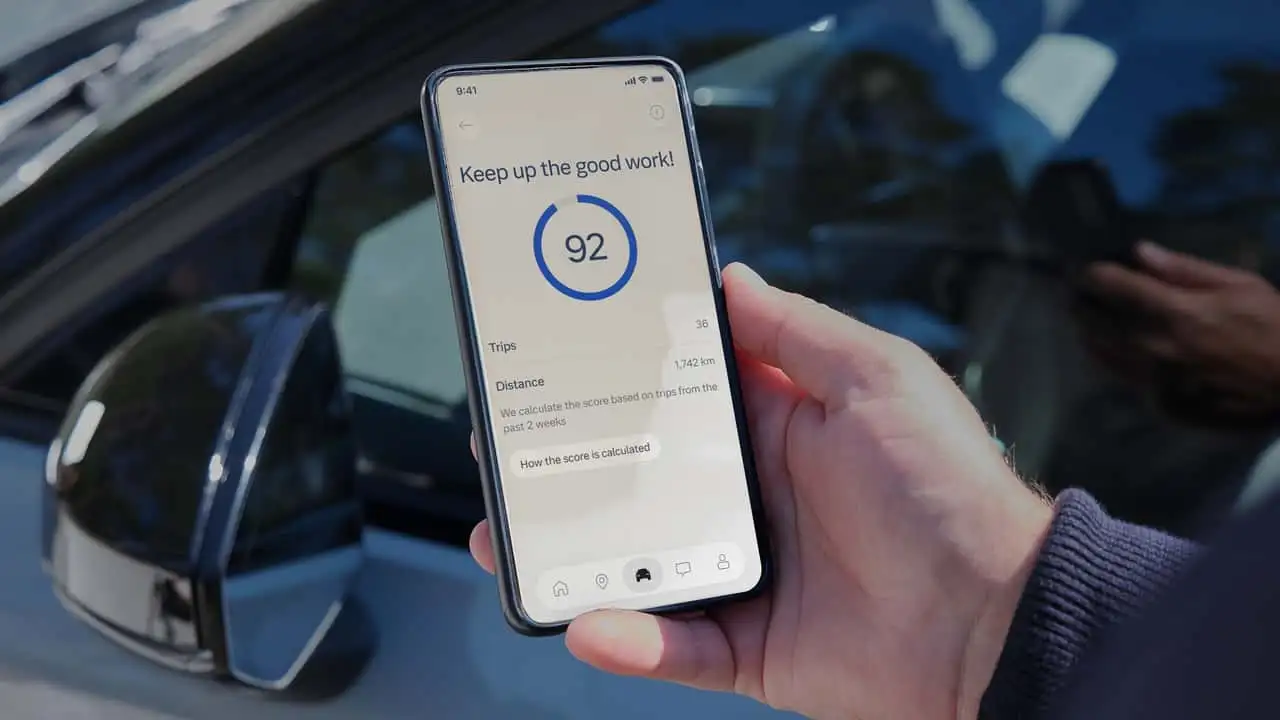
The company’s new Safety Coach app monitors how drivers behave behind the wheel, provides personalised feedback and gives them a dynamic safety score.
The idea is straightforward: encourage drivers to brake more smoothly, accelerate more responsibly, avoid unnecessary hard cornering and maintain more predictable driving habits.
But there is another potential benefit.
In markets where Volvo’s insurance programme is available, drivers who choose to share their driving data could become eligible for usage-based insurance offers that may reduce their premiums.
Volvo is initially launching Safety Coach in Sweden and Norway, with plans to expand it to the United States and other European markets. Insurance-related offers are also planned as the system expands.
That makes Safety Coach an interesting example of how connected cars are changing the relationship between driving behaviour, vehicle technology and insurance.
What is Volvo Safety Coach?
Safety Coach is an optional feature that uses information about a driver’s everyday behaviour to provide personalised driving feedback.
The system looks at factors including:
- Braking
- Acceleration
- Cornering
- Speed
- Driving patterns
It then generates a personal Safety Coach score for the driver.
The score is dynamic, meaning it can change as driving behaviour changes.
Rather than simply telling a driver that they made a mistake, the system is designed to provide ongoing feedback that can encourage safer habits over time.
The feedback can appear through the vehicle’s infotainment system and the Volvo Cars mobile app.
Volvo wants drivers to become more predictable
One of the ideas behind the system is that safer driving isn’t necessarily about driving slowly all the time.
It is also about being predictable.
Volvo driver-behaviour expert Mikael Ljung Aust says unexpected situations contribute to many crashes.
A driver who avoids abrupt acceleration, sudden braking and unpredictable manoeuvres gives other road users more time to react.
That principle is particularly important in busy urban environments.
A driver who suddenly changes speed or direction can create a dangerous situation even if they aren’t technically speeding.
Safety Coach is designed to identify some of these behaviours and help drivers understand them.
How does the scoring work?
Volvo developed Safety Coach in collaboration with Cambridge Mobile Telematics (CMT).
CMT’s algorithm is used to generate the individual Safety Coach score.
Telematics technology allows information about vehicle use and driving behaviour to be collected and analysed.
This technology is already being used by insurers and fleet operators in various forms.
The difference with Safety Coach is that Volvo is putting the feedback directly into the driver’s everyday vehicle experience.
Instead of receiving a report from an insurance company after months of driving, the driver can potentially see feedback while building habits over time.
The insurance connection is particularly interesting
This is arguably the most commercially significant part of Safety Coach.
Volvo says customers in Sweden and Norway will soon have access to a special offer from Volvia, an insurance company affiliated with Volvo, if they choose to share their driving data.
Safer driving could then be rewarded with more favourable insurance premiums.
This is an example of usage-based insurance.
Instead of calculating premiums primarily from broad characteristics such as age, vehicle type and location, insurers can incorporate actual driving behaviour into their pricing.
The concept has existed for years.
Connected vehicles are making it much easier to collect the necessary information.
But drivers aren’t automatically guaranteed a discount
This is an important distinction.
Volvo’s announcement does not mean every Safety Coach user will automatically receive a cheaper insurance policy.
The insurance benefit depends on the relevant insurance programme and the driver’s participation.
Volvo says customers must choose to share their driving data with affiliated insurers in exchange for usage-based insurance premiums.
So the correct way to describe the feature is:
Safety Coach could help eligible drivers qualify for better insurance rates.
It should not be described as a guaranteed discount.
Drivers remain in control of their data
The insurance connection also raises an obvious question:
What happens to all the driving data?
Volvo says Safety Coach has been designed with privacy and transparency in mind.
Drivers can opt in to Safety Coach and can separately choose whether to share their data with affiliated insurance companies.
Volvo says drivers can disable the Safety Coach feature at any time.
That distinction is important.
Using a connected safety feature does not automatically mean that an insurance company receives all of the driver’s information.
The driver has a separate choice regarding insurance data sharing.
What kind of data does Safety Coach use?
Volvo’s privacy documentation provides a more detailed picture.
Depending on the implementation, information used for Safety Coach can include:
- Volvo ID
- Vehicle identification number
- Vehicle location
- Routes
- Speed
- Acceleration
- Gyroscope information
- Compass information
- Time
- Mileage
Volvo says this information is used to provide driving insights and advice about safer driving habits.
The system also involves automated decision-making because it evaluates and scores driving behaviour.
Volvo’s privacy documentation says this scoring is not intended to have significant or legal effects on the driver and that the Safety Coach feature can be disabled.
For consumers, this is an important part of understanding connected-car technology.
The benefits may be attractive, but drivers should also understand what information is being collected and how it can be used.
Which Volvo cars can use it?
The initial rollout is aimed at most Volvo vehicles from model year 2020 onward that have the required Google Android-based infotainment system.
The exact availability can vary by market and vehicle.
This means Safety Coach isn’t necessarily a feature that every Volvo owner worldwide can activate immediately.
The rollout is starting in Sweden and Norway before expanding to other markets.
Why is Volvo starting in Sweden and Norway?
There is a practical reason.
Volvo can launch both sides of the concept in those markets:
Safety Coach + insurance incentives.
Customers in Sweden and Norway will be able to use the driving-feedback system and potentially participate in Volvia’s usage-based insurance offering.
That allows Volvo to test the complete model rather than simply launching a driving-score app without a financial incentive.
If drivers respond positively, Volvo can then expand the concept to other markets.
The United States is next
Volvo says Safety Coach is planned for introduction in the United States and other European markets following the initial Swedish and Norwegian rollout.
Insurance-related offers are also planned as part of that expansion.
However, Volvo has not said that every U.S. driver will automatically receive an insurance discount.
The insurance arrangements will depend on the market and participating insurers.
That distinction will become increasingly important as connected-car insurance programmes expand.
This isn’t entirely new
Volvo isn’t the first company to use driving data to score motorists.
Usage-based insurance programmes have existed for years.
Telematics devices and smartphone apps can already monitor things such as:
- Speed
- Hard braking
- Rapid acceleration
- Time of day
- Distance travelled
- Driving location
The difference is that Volvo is integrating the system directly into the vehicle and making driver improvement one of the central purposes.
It isn’t merely an insurance monitoring device.
It is being positioned as a digital driving coach.
Volvo’s approach is similar to a fitness tracker
There is an interesting way to think about Safety Coach.
A fitness tracker doesn’t make someone healthier by itself.
Instead, it gives people information about their behaviour.
A person might see that they walked 4,000 steps today and decide to walk more tomorrow.
Safety Coach works on a similar principle.
If a driver repeatedly receives feedback about hard braking or aggressive acceleration, they may begin changing their driving habits.
Over time, those small changes could potentially become automatic.
Could a safety score actually change behaviour?
Volvo and Cambridge Mobile Telematics believe it can.
CMT says its safe-driving programmes have typically seen reductions in behaviours such as speeding and hard braking among people who actively participate.
That doesn’t mean every Safety Coach user will become a safer driver.
Some people may ignore the score.
Others may become overly focused on improving it.
But the concept is interesting because it provides continuous feedback rather than relying solely on driver education after an accident or traffic violation.
There could be a psychological benefit
Driving is often habitual.
People may not realise how frequently they brake aggressively or accelerate sharply.
A safety score makes those behaviours visible.
That could create a feedback loop:
Drive → receive feedback → change behaviour → receive a better score → reinforce the new behaviour.
If the system works as intended, the technology eventually becomes less important than the habits it creates.
The goal isn’t to produce a perfect score.
It’s to make safer behaviour routine.
But safety scores can also create problems
There is another side to the idea.
Once a driving score is connected to money, drivers may become more concerned about the score itself than about driving safely.
For example, a driver might become reluctant to brake hard even when emergency braking is appropriate.
That would obviously be undesirable.
A good safety system therefore needs to distinguish between genuinely risky behaviour and necessary emergency manoeuvres.
The scoring algorithm becomes extremely important.
Insurance creates another layer of complexity
Insurance pricing is ultimately about risk.
If telematics can reliably identify safer drivers, insurers have an incentive to reward them.
But there is also a potential downside.
Drivers who receive poor scores could potentially pay more.
That means technology intended to reward safe driving could also create a new form of risk classification.
Volvo’s initial programme is being presented around rewards and safer habits, but the broader usage-based insurance industry will have to address questions around fairness, transparency and data use.
What happens if your driving score is poor?
Volvo’s public announcement focuses on helping drivers improve their behaviour.
It does not say that a poor Safety Coach score automatically means a higher insurance premium.
That distinction matters.
The system is being introduced primarily as an optional coaching tool, with insurance benefits connected to voluntary data sharing in participating markets.
Drivers shouldn’t therefore assume that simply using Safety Coach exposes them to an automatic insurance penalty.
The precise insurance terms will depend on the participating insurer and market.
Could this make cars safer?
Potentially.
Modern cars already contain enormous amounts of safety technology.
Automatic emergency braking can detect potential collisions.
Lane-keeping systems can help drivers stay within their lanes.
Adaptive cruise control can maintain distance from vehicles ahead.
Blind-spot monitoring can warn about nearby traffic.
But these systems don’t necessarily change the underlying behaviour of the driver.
Safety Coach takes a different approach.
Instead of the car simply protecting the driver from mistakes, it tries to teach the driver to make fewer mistakes in the first place.
That could be an important next step in automotive safety.
It also shows how cars are becoming data platforms
Modern vehicles are increasingly connected computers on wheels.
They can monitor:
- Location
- Battery status
- Vehicle health
- Charging
- Driving behaviour
- Navigation
- Driver preferences
- Software usage
Safety Coach demonstrates another consequence of that connectivity.
The vehicle can analyse not only what the car is doing, but also how the person is driving it.
That creates opportunities for better safety and insurance.
It also creates new privacy responsibilities.
What does this mean for EVs?
Although Safety Coach isn’t exclusively an electric-vehicle technology, it fits particularly well with the connected EV era.
Modern EVs already rely heavily on software.
Many receive over-the-air updates.
They collect large amounts of driving and energy data.
They use smartphone apps.
And they increasingly integrate digital services directly into the vehicle.
As that ecosystem expands, features like Safety Coach become easier to introduce.
The car effectively becomes a software platform that can learn from how it is being used.
Could this eventually become standard across the industry?
Very possibly.
If usage-based insurance programmes demonstrate that driver behaviour can be measured reliably and used to reduce accident risk, other manufacturers are likely to follow.
Automakers could potentially offer:
- Safety coaching
- Insurance discounts
- Fleet safety programmes
- Driver training
- Teen-driver monitoring
- Eco-driving scores
- Predictive maintenance
The same sensors and connected systems could support all of these services.
There is also an environmental angle
Safer driving and efficient driving can overlap.
Aggressive acceleration and unnecessary braking can increase energy consumption.
That applies to both petrol cars and EVs.
For an electric vehicle, smoother driving can potentially help maximise range.
For a combustion vehicle, efficient driving can reduce fuel consumption.
So a technology designed primarily for safety could also encourage more efficient driving.
That gives Safety Coach a small but interesting connection to the broader sustainability conversation.
What about Nigeria and Africa?
This technology could eventually be interesting in African markets, but there are several challenges.
Insurance systems vary considerably between countries.
Telematics infrastructure and data regulations also differ.
And not every market has the same level of connected-vehicle adoption.
Nigeria, for example, has a growing automotive technology ecosystem but remains very different from Sweden or Norway in terms of insurance pricing, connected-car penetration and road infrastructure.
That means Volvo would need to adapt the system to local conditions rather than simply copying the European insurance model.
The safety concept, however, could still have value.
Why driver coaching could matter in African cities
Many African cities have complex traffic environments.
Drivers regularly encounter:
- Congestion
- Motorcycles
- Pedestrians
- Poorly marked roads
- Sudden lane changes
- Unpredictable traffic behaviour
A system that helps drivers become more predictable could potentially have benefits in these environments.
But the algorithm would need to understand local road conditions.
A driving behaviour that looks unusual in a Scandinavian city might be completely normal in Lagos traffic.
This is one reason local calibration will matter if technologies like Safety Coach eventually expand across Africa.
The bigger opportunity may be insurance
For GoGreenway readers, perhaps the most interesting aspect isn’t even the safety score.
It’s the possibility of personalised insurance.
Imagine a future where your insurer doesn’t simply ask:
“What car do you drive?”
Instead, it can also ask:
“How do you actually drive?”
That could fundamentally change motor insurance.
A careful driver could potentially pay less.
A consistently aggressive driver could potentially pay more.
The model could make insurance pricing more closely connected to individual risk.
But it also makes privacy and transparency much more important.
GoGreenway’s take
Volvo’s Safety Coach is an interesting example of where the connected-car industry is heading.
The idea isn’t revolutionary by itself. Telematics-based insurance and driving scores already exist.
What makes Volvo’s approach interesting is the attempt to combine driver education, real-time feedback and insurance incentives in one system.
If the technology genuinely encourages safer driving, everyone potentially benefits:
Drivers could develop better habits.
Insurers could gain better information about risk.
Automakers could strengthen their safety credentials.
Road users could potentially benefit from fewer dangerous driving behaviours.
But there is a second side to the story.
The more cars know about their drivers, the more important data privacy becomes.
Drivers need to understand what information is being collected, who can access it and what consequences could result from sharing it.
For now, Volvo appears to be taking a relatively cautious approach by making Safety Coach optional and giving drivers a separate choice about sharing data with insurers.
The real test will come as the system expands beyond Sweden and Norway.
If Volvo can demonstrate that a digital coach can actually change driving behaviour — while giving drivers meaningful insurance savings without compromising privacy — Safety Coach could become an important model for the next generation of connected vehicles.