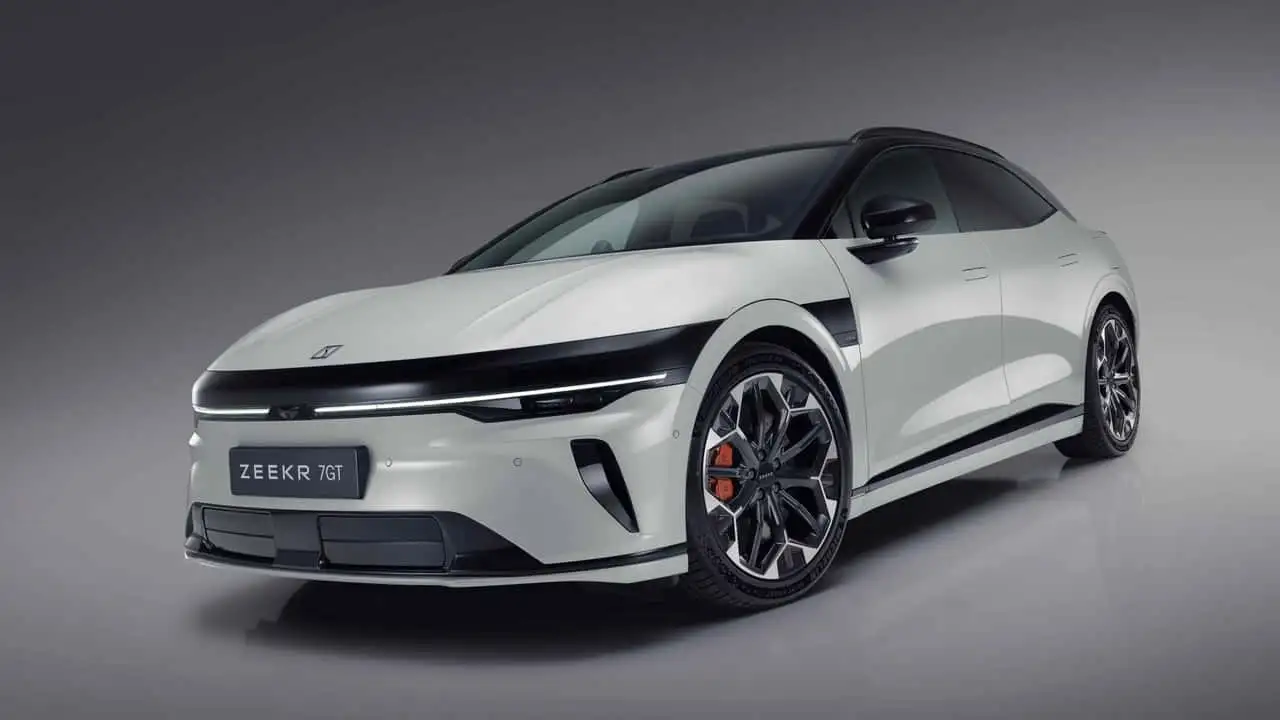
The Zeekr 7GT has been making headlines for one particularly impressive number: its ability to charge extremely quickly.
But a recent charging test has revealed something even more interesting.
The electric shooting brake managed to go from 10% to 80% battery charge in roughly 11 minutes, despite never coming close to its advertised peak charging power.
The 75-kWh version tested reached only around 325 kW at its peak, substantially below the theoretical maximum advertised for the vehicle.
And yet it still beat Zeekr’s own 13-minute 10–80% charging claim.
That might sound contradictory.
It isn’t.
The test demonstrates an important lesson about EV charging:
Peak charging power isn’t everything.
The Zeekr 7GT didn’t hit its headline charging figure
Zeekr has positioned the 7GT as one of Europe’s fastest-charging electric cars.
The car uses an 800-volt electrical architecture, and depending on the market and configuration, Zeekr advertises extremely high DC charging capability. Its European website says the 7GT can charge from 10% to 80% in as little as 13 minutes using a suitable charger.
Some versions are advertised with charging capability of up to around 480 kW.
That is an extraordinary number.
For comparison, many popular EVs still operate far below 300 kW.
But in the independent test of the 75-kWh LFP version, the car didn’t come close to 480 kW.
It peaked at approximately 325 kW.
And it reportedly reached similar peak levels on multiple chargers.
So why was the charging time still so impressive?
Because the charging curve matters more than the peak
This is perhaps the most important takeaway from the test.
When an EV charges, it doesn’t normally pull its maximum power throughout the entire session.
Instead, charging power usually rises, reaches a peak and then gradually falls as the battery fills.
This is known as the charging curve.
A vehicle might advertise a 400-kW peak, for example, but only hold that power for a short period.
Another vehicle might peak at 300 kW but maintain something close to that level for considerably longer.
The second vehicle could therefore finish charging sooner.
That’s essentially what happened with the Zeekr 7GT.
The 7GT’s charging curve stays unusually strong
The tested 7GT didn’t need to reach its theoretical maximum.
Instead, it maintained relatively high charging power well into the charging session.
According to the test, the vehicle was still pulling roughly 165 kW at 90% state of charge.
It then reached 100% in approximately 21 minutes from the initial 10% starting point.
That is remarkable because many EVs dramatically reduce charging power as the battery approaches full.
The Zeekr’s ability to maintain substantial power later in the session is one of the reasons its overall charging time is so competitive.
The 11-minute result actually beats Zeekr’s claim
Zeekr officially claims around 13 minutes from 10% to 80% for the smaller battery under suitable conditions.
The independent test completed that same charging window in approximately 11 minutes.
That’s roughly two minutes faster than the advertised figure.
For an EV manufacturer, that is a good result.
It suggests that the published charging figure isn’t merely a theoretical laboratory number that the vehicle struggles to achieve.
Under the right conditions, the car can actually outperform it.
But there is an important qualification
This doesn’t mean every Zeekr 7GT will charge from 10% to 80% in 11 minutes.
EV charging speeds depend on several variables.
These include:
- Charger output
- Battery temperature
- Battery state of charge
- Charging station voltage
- Current available
- Battery preconditioning
- Ambient temperature
- Vehicle software
- Charger compatibility
The test itself was performed under favourable conditions.
Real-world charging times can therefore be longer.
That’s true of virtually every EV.
The battery is an important part of the story
The version tested was the 75-kWh LFP model.
LFP stands for lithium iron phosphate, a battery chemistry increasingly used in electric vehicles.
LFP batteries have several advantages.
They are generally considered durable and thermally stable, and they avoid the use of nickel and cobalt found in many nickel-manganese-cobalt battery packs.
But historically, LFP batteries haven’t always been associated with extremely fast charging.
The Zeekr 7GT challenges that assumption.
Zeekr’s Golden Battery technology
The 75-kWh battery in the tested car uses Zeekr’s own second-generation Golden Battery technology.
The company has invested heavily in battery engineering as it tries to differentiate its vehicles from competitors.
The charging test suggests that Zeekr’s battery and thermal-management strategy can deliver very high sustained charging power.
That’s arguably more useful to drivers than a spectacular peak number that lasts only a few seconds.
Why 10–80% matters
You may wonder why EV manufacturers and reviewers keep talking about 10–80% rather than 0–100%.
There’s a good reason.
The final portion of an EV battery charge is generally much slower.
As the battery approaches full capacity, the vehicle reduces charging power to protect the cells and manage heat.
So charging from 80% to 100% can take disproportionately longer than charging from 10% to 80%.
For long-distance travel, drivers therefore often stop at around 70–80% and continue their journey.
That makes 10–80% a useful benchmark for comparing fast-charging capability.
An 11-minute stop changes the EV road-trip equation
Imagine arriving at a highway charging station with 10% battery.
You plug in.
You walk into the station.
You buy a drink.
Maybe you use the restroom.
Before you’ve barely settled in, the vehicle is already at 80%.
That’s fundamentally different from the charging experience associated with many older EVs.
And it gets closer to the convenience of refuelling a petrol car.
It doesn’t completely eliminate the difference.
But it significantly reduces it.
Charging speed may be more important than range
The EV industry has traditionally focused heavily on battery range.
Manufacturers advertise numbers such as:
400 miles.
500 miles.
600 kilometres.
But there is another way to look at the problem.
Instead of asking:
How far can this EV go on one charge?
You could ask:
How quickly can this EV recover another 200 or 300 kilometres?
That’s where cars like the Zeekr 7GT become interesting.
A vehicle with moderate range but extremely fast charging could potentially be more convenient on long journeys than an EV with a larger battery but much slower charging.
Zeekr says 10 minutes can add hundreds of kilometres
The company claims that the 7GT can add approximately 340 km of range in 10 minutes under suitable conditions.
That figure should not be interpreted as a universal real-world result.
Range added depends on the battery version, driving conditions and charging conditions.
But it demonstrates the philosophy behind the car.
Zeekr isn’t simply trying to give the 7GT a huge battery.
It is trying to make the battery quick to replenish.
The 7GT comes with two battery sizes
The 7GT is available with different battery configurations.
The European range includes a smaller battery around 75 kWh and a larger battery around 100 kWh, depending on the version.
The smaller battery is particularly interesting because it shows that a relatively modest battery can still provide an impressive long-distance experience when charging is extremely fast.
The larger battery, meanwhile, provides greater range for drivers who prioritise fewer charging stops.
Range varies significantly between versions
Official WLTP figures differ depending on the configuration.
The Core RWD is rated at up to roughly 519 km, while the Long Range RWD can reach approximately 655 km.
The higher-performance AWD version is rated at around 558 km.
Those figures aren’t directly comparable with the 11-minute charging test because range and charging depend on different configurations.
But they show that Zeekr is targeting several different types of buyer.
The 7GT is more than a charging-speed experiment
It’s easy to focus on the charging headline and overlook the vehicle itself.
The 7GT is a sleek electric shooting brake, essentially combining some of the practicality of a wagon with the proportions and styling of a sporty car.
It sits in an interesting part of the market.
SUVs dominate the EV industry, but Zeekr is attempting to make the electric wagon relevant again.
Performance is also strong
The 7GT isn’t a slow family car designed purely around efficiency.
The different versions offer substantially different performance.
The Core RWD, for example, produces around 310 kW and can accelerate from 0–100 km/h in approximately 5.3 seconds.
The range-topping AWD model is considerably quicker.
That gives the 7GT a useful combination:
Long-distance capability + fast charging + strong performance.
The 800-volt architecture is crucial
The vehicle’s electrical architecture is a major reason it can charge so quickly.
The 7GT uses an 800-volt platform.
Higher-voltage systems can deliver large amounts of electrical power without requiring proportionally enormous current.
That’s important because extremely high current creates engineering challenges involving:
- Heat
- Cable size
- Charging hardware
- Electrical losses
- Battery thermal management
An 800-volt system helps manufacturers push charging speeds higher.
But the charger is just as important
There’s an easy misconception about ultra-fast EV charging.
Buying a car capable of 400 or 480 kW doesn’t mean you’ll automatically receive that power at every charging station.
The charger has to be capable of delivering it.
If you connect a Zeekr 7GT to a 150-kW charger, it can’t magically pull 400 kW.
It will be limited by the charging station.
This is one of the biggest practical limitations of ultra-fast charging.
Charging infrastructure has to catch up
The 7GT’s technology is impressive.
But the usefulness of that technology depends heavily on infrastructure.
A vehicle capable of 480 kW charging is most valuable when there are enough chargers capable of supplying hundreds of kilowatts.
That’s already becoming more common in parts of Europe and China.
It is far less common in many developing EV markets.
And that brings us to Africa.
What does this mean for Nigeria?
From a Nigerian perspective, the Zeekr 7GT is fascinating but also highlights one of the biggest challenges facing EV adoption.
The car can charge incredibly quickly.
But where can you find a charger capable of delivering that power?
Nigeria’s public EV charging network is still developing.
Even when high-powered chargers are available, reliability, electricity supply and charger availability can be bigger concerns than the maximum charging capability of the vehicle.
A 480-kW-capable EV connected to a much slower charger isn’t fundamentally different from another EV at that moment.
The infrastructure determines the experience.
Nigeria doesn’t necessarily need 480-kW chargers everywhere
There’s another important point.
A country doesn’t need ultra-high-power chargers at every location for EV adoption to work.
Most EV charging happens at home or at destinations.
A driver who leaves home with a full battery may not need a DC fast charger for days.
High-power charging is most valuable for:
- Highway travel
- Long-distance trips
- Commercial fleets
- Taxi services
- Busy urban charging hubs
For Nigeria, strategically placed fast chargers along major highways could therefore be more useful than thousands of extremely expensive ultra-high-power chargers scattered randomly.
The technology is still important even if the infrastructure isn’t ready
This is where vehicles like the 7GT matter.
Automakers are effectively pushing the infrastructure industry.
If cars can accept 400 kW or more, charging networks have an incentive to build higher-powered stations.
As more vehicles gain the capability, ultra-fast charging could gradually become more normal.
The same thing happened with smartphone charging.
Once phones began supporting faster charging, consumers started expecting it.
EVs could follow a similar path.
Peak power numbers can be misleading
The Zeekr test provides a useful lesson for EV buyers generally.
Don’t judge an EV’s charging capability by the highest number in the specification sheet.
Instead, ask:
How long does it maintain high power?
How quickly does it reach 80%?
What happens after 80%?
How much range does it actually add during a typical charging stop?
Those questions tell you much more about the real-world experience.
A flat charging curve can be better than a huge peak
This is exactly what the 7GT demonstrates.
Its tested peak was around 325 kW.
That’s already extremely fast.
But the more impressive part was how long it maintained substantial charging power.
That allowed the vehicle to complete 10–80% in approximately 11 minutes.
The lesson is simple:
Sustained charging power beats headline charging power.
This could be more important as EV batteries get larger
Large batteries are becoming increasingly common in premium EVs.
That’s useful for range.
But a larger battery also means that charging it can take longer if the charging system isn’t equally capable.
Ultra-fast charging provides a solution.
Instead of simply installing ever-larger batteries, manufacturers can make the existing battery faster to replenish.
That could reduce the need for enormous battery packs.
Smaller batteries could become more attractive
This is an interesting consequence.
If charging becomes extremely fast, consumers may no longer need a giant battery simply to avoid long charging stops.
A smaller, lighter battery could provide adequate range while being significantly faster to recharge.
That could have environmental and economic benefits.
Smaller batteries require fewer raw materials.
They can reduce vehicle weight.
And lighter vehicles can be more energy efficient.
But battery size isn’t the only factor
Charging speed also depends on battery chemistry and thermal management.
The battery has to be able to accept large amounts of energy without overheating or degrading excessively.
That’s why ultra-fast charging is as much a battery-engineering challenge as it is a charger challenge.
Zeekr’s result suggests that its battery and thermal-management systems are performing well under the test conditions.
What happens to battery health?
Fast charging inevitably raises questions about battery degradation.
Repeated exposure to very high charging power can place additional thermal and electrochemical demands on a battery.
Modern EVs therefore use sophisticated battery-management systems to control temperature and charging power.
The 7GT’s ability to charge quickly doesn’t automatically mean its battery will degrade rapidly.
But long-term real-world data will be important.
That’s something consumers won’t know immediately from a new vehicle.
Zeekr is trying to change the EV charging conversation
For years, the discussion around EV charging was mostly about range anxiety.
How far can the car travel?
Where are the chargers?
How long will I have to wait?
Cars like the 7GT attack the third question directly.
If a charging stop takes around 10–15 minutes under ideal conditions, waiting becomes much less intimidating.
The technology doesn’t eliminate range anxiety.
But it reduces one of its biggest causes.
How does this compare with filling a petrol car?
Petrol still has one major advantage.
A typical petrol car can be refuelled in a few minutes almost anywhere there is a filling station.
Ultra-fast EV charging is getting closer.
But it isn’t identical.
The charging station must have sufficient power.
The vehicle must be warm enough.
The battery must be at an appropriate state of charge.
And the charger must actually be available.
So EVs still have some practical disadvantages.
The gap is simply getting smaller.
The charging test is arguably more impressive than the 480-kW claim
This is my biggest takeaway from the Zeekr story.
If the 7GT had reached 480 kW for a few seconds but still needed 15 or 20 minutes to charge, the headline number wouldn’t mean much.
Instead, it achieved an 11-minute 10–80% result while peaking at only about 325 kW.
That tells us something genuinely useful about the vehicle.
The system appears to be designed around sustained charging performance rather than a single spectacular peak.
GoGreenway’s verdict
The Zeekr 7GT’s latest charging test is a good reminder that EV specifications need context.
The car didn’t come close to its advertised peak charging capability during the test.
At roughly 325 kW, it was more than 150 kW below the headline figure.
Yet it still completed a 10–80% charge in about 11 minutes, beating Zeekr’s own 13-minute claim.
That’s arguably more impressive than hitting 480 kW for a few seconds.
The 7GT shows that the future of EV charging isn’t necessarily about achieving the biggest possible peak.
It is about creating a charging curve that stays strong for as long as possible.
For consumers, that’s the number that matters.
Because when you’re sitting at a highway charger, you don’t care whether the car briefly reached 480 kW.
You care about one thing:
How quickly can I get back on the road?
And based on this test, the Zeekr 7GT has a very convincing answer.
Sources
- Zeekr Europe — official 7GT specifications and charging claims.
- InsideEVs — independent charging test showing approximately 325 kW peak and an 11-minute 10–80% result.
- The Car Expert — independent road test covering the 7GT’s range and charging characteristics.
- Carsales — independent review and range/performance assessment.
- Electrifying — technical review of the 7GT’s charging capability and battery options.