The Volvo EX30 is small, electric and unmistakably different from most of the cars wearing the Volvo badge.
It is also one of the most important electric vehicles Volvo has introduced in recent years.
The EX30 was designed to bring Volvo’s electric-car technology into a much smaller and more affordable package. At around 4.23 metres long, it is considerably smaller than Volvo’s larger electric SUVs, making it particularly suited to urban driving.
But the EX30 is not simply a smaller Volvo.
It represents a different approach to what an electric SUV can be.
It has a minimalist interior, a screen-focused dashboard, strong acceleration and a choice of rear-wheel-drive and all-wheel-drive powertrains.
And although its small dimensions make it easy to manoeuvre, they also create some compromises.
So, is Volvo’s smallest electric SUV actually worth considering?
Here’s everything you need to know.
What Is the Volvo EX30?
The EX30 is Volvo’s smallest SUV and one of its smallest vehicles overall.
It is a fully electric crossover designed primarily for urban and everyday driving.
Unlike the larger EX90, the EX30 isn’t trying to be a huge family SUV.
Instead, Volvo has focused on making it:
- Compact
- Efficient
- Easy to park
- Relatively affordable
- Quick
- Technologically advanced
That makes the EX30 particularly interesting for people who want an electric vehicle but don’t want a large SUV.
It Is Small — And That’s the Point
The EX30 measures approximately 4,233 mm long and 1,838 mm wide, excluding mirrors. Its wheelbase is 2,650 mm.
Those dimensions put it firmly in the small-SUV/crossover category.
That has several advantages.
The car is easier to manoeuvre through crowded streets.
Parking is easier.
It takes up less space.
And its relatively small footprint can help reduce energy consumption compared with a much larger electric SUV.
But there is an obvious trade-off.
A small exterior means a small interior.
And that’s one of the EX30’s biggest weaknesses.
The Rear Seats Are Tight
The EX30 officially has seating for five people.
But that doesn’t mean five adults will be comfortable on a long journey.
Independent testing from Edmunds found the rear seat particularly cramped, describing it as one of the vehicle’s major weaknesses.
This is important because the EX30 looks like an SUV.
Some buyers may therefore expect considerably more interior space than the vehicle actually provides.
If you regularly carry adults in the back, you should consider a larger EV.
Cargo Space Is Also Limited
The same issue appears in the luggage area.
Edmunds lists 12.4 cubic feet of cargo capacity behind the rear seats for the U.S.-specification model.
That’s not particularly large for an SUV.
Volvo’s European specifications use different measurement standards and list up to 318 litres of luggage space with the second row in place, depending on the measurement configuration.
The takeaway is simple:
The EX30 is a small crossover, not a substitute for a large family SUV.
What Does the EX30 Look Like?
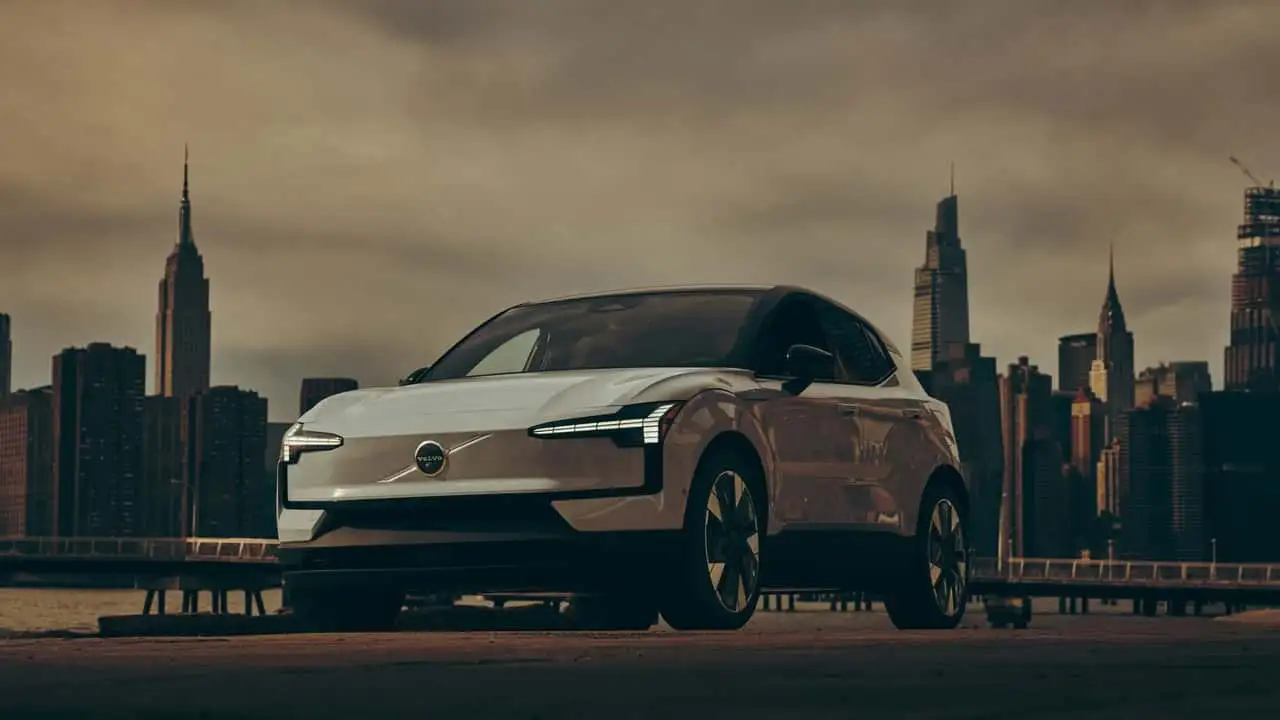
Volvo has given the EX30 a clean, minimalist design.
The front end doesn’t need a conventional grille because there is no petrol engine requiring traditional cooling airflow.
The headlights use Volvo’s familiar “Thor’s Hammer” design language.
The body is relatively upright, giving it the visual proportions of an SUV while keeping the overall footprint compact.
It looks unmistakably like a Volvo.
But it also looks more youthful than some of the company’s larger models.
The Interior Is Very Different
The interior is arguably the most controversial part of the EX30.
Volvo has removed many of the traditional controls found in conventional cars.
Instead, the central touchscreen controls a large number of functions.
The approach is extremely minimalist.
There is very little clutter.
But minimalist doesn’t always mean easier to use.
Edmunds specifically criticises the touchscreen-heavy approach because some functions can be distracting to operate while driving.
Almost Everything Happens Through the Screen
The central screen handles:
- Navigation
- Media
- Vehicle settings
- Climate controls
- Some driver-assistance functions
- Smartphone connectivity
It gives the cabin a very clean appearance.
But it also means drivers have to interact with the screen for functions that other cars might provide with physical buttons.
That’s a trade-off.
Some owners will love the clean design.
Others will prefer traditional controls.
Volvo’s Scandinavian Approach Is Everywhere
The minimalist interior isn’t just about saving space.
Volvo has also tried to make the EX30’s cabin more sustainable.
Different interior themes use recycled and renewable materials.
The company has placed considerable emphasis on reducing the environmental footprint of the vehicle.
That fits the EX30’s wider positioning.
This isn’t just supposed to be a small EV.
It’s supposed to demonstrate how Volvo can build a more resource-conscious vehicle.
The EX30 Uses Recycled Materials
Depending on the interior specification, Volvo uses materials that incorporate recycled content.
Examples include recycled plastics and other recovered materials.
The goal is to reduce dependence on newly produced raw materials.
This is an important part of the sustainability story.
But recycled content alone doesn’t make a vehicle environmentally friendly.
The complete lifecycle matters, including manufacturing, electricity generation, vehicle use and eventual recycling.
What Battery Does the EX30 Use?
The battery depends on the version.
Volvo currently lists both a smaller battery option and a 69-kWh battery for its longer-range models in markets such as the UK.
The 69-kWh battery is the important one for buyers interested in maximum range.
It is paired with a rear-mounted electric motor in the Long Range version.
The Single-Motor Version Makes the Most Sense for Range
The rear-wheel-drive Single Motor Extended Range model is arguably the most interesting version of the EX30.
It uses:
69-kWh battery
272 hp
343 Nm of torque
Rear-wheel drive
Volvo quotes up to 303.9 miles WLTP for the Long Range version in the UK, while the U.S. EPA rating is 261 miles.
That difference illustrates why EV range figures should always be labelled by testing standard.
WLTP and EPA results are not directly interchangeable.
Real-World Range Is Better Than the Official Number
This is one of the most interesting developments since the EX30 first launched.
Edmunds tested the 2026 EX30 Single Motor Extended Range and achieved 279 miles in its real-world EV Range Test.
That’s about 6.7% more than its 261-mile EPA estimate.
The result suggests the EX30 can deliver respectable real-world efficiency despite its relatively small battery.
The EX30 Is Surprisingly Efficient
The Single Motor version recorded 26.1 kWh per 100 miles during Edmunds’ testing.
That’s better than the EPA’s 29 kWh/100-mile figure for that configuration.
Efficiency is important because it means Volvo doesn’t have to install an enormous battery to achieve useful range.
A smaller battery can potentially mean:
- Less weight
- Lower material demand
- Lower energy consumption
- Potentially lower production costs
That’s a positive from both an engineering and sustainability perspective.
What About the Twin Motor?
If you want performance rather than maximum efficiency, Volvo offers the Twin Motor Performance version.
It uses two electric motors and all-wheel drive.
The result is considerably more power.
Volvo lists the current P8 AWD version at 428 hp, with a 0–62 mph time of just 3.6 seconds.
That’s extremely quick for a small SUV.
In fact, it’s faster than many sports cars from not very long ago.
But Performance Costs Range
The Twin Motor version has the same nominal 69-kWh battery in Volvo’s current UK specifications, but the extra motor and power result in higher energy consumption.
Volvo quotes up to 279.6 miles WLTP for the P8 AWD version, compared with up to 303.9 miles for the Long Range rear-wheel-drive version.
Edmunds also found a meaningful difference in independent testing.
Its Twin Motor test car travelled 256 miles, compared with 279 miles for the Single Motor.
So if range matters more than acceleration, the rear-wheel-drive version is the smarter choice.
0–60 mph Is Surprisingly Quick
The EX30 is not a slow city EV.
Even the Single Motor Extended Range produces 268–272 hp depending on market specification.
Edmunds says its tested Single Motor model can reach 60 mph in about 5.1 seconds.
The Twin Motor Performance version is dramatically quicker.
That instant electric torque makes the EX30 feel much more energetic than its small size might suggest.
It’s Easy to Drive Around Town
This is where the EX30 makes a lot of sense.
Its compact dimensions make it easy to manoeuvre.
The seating position gives the driver a good view of the road.
And the immediate response of the electric motor makes it easy to pull into traffic.
For cities with narrow streets and difficult parking, a small electric SUV can be more practical than a large EV.
Charging Is Reasonably Fast
The EX30 supports DC fast charging.
For the 69-kWh battery, Volvo quotes approximately 28 minutes for a 10–80% charge when using an appropriately powerful DC charger.
That’s competitive, although not class-leading.
Edmunds’ testing found that the EX30 added 100 miles of range in an average of around 17 minutes during its fast-charging tests.
Some Hyundai and Kia EVs can add the equivalent amount of range considerably faster.
Home Charging Is More Important
For most EX30 owners, home charging will probably matter more than maximum DC charging speed.
Volvo quotes around eight hours for a full AC charge using suitable three-phase 16A charging equipment with the 69-kWh battery.
That means an owner can plug the car in overnight and start the next day with a full battery.
This is one of the biggest advantages of owning an EV if you have reliable home charging.
What About Nigeria?
This is where the EX30 becomes an interesting proposition for GoGreenway readers.
For a Nigerian buyer, the biggest question isn’t necessarily:
“How fast can it charge?”
It’s:
“Where will I charge it?”
If you have reliable electricity and a suitable home charging installation, the EX30 could work well as an urban vehicle.
If you depend entirely on public charging, the ownership experience becomes much more dependent on the availability and reliability of charging stations.
Its Compact Size Could Be an Advantage in Lagos
The EX30’s dimensions make sense for dense urban environments.
It is significantly easier to manoeuvre than a large three-row electric SUV.
That could be useful in Lagos traffic and crowded urban areas.
And because it is electric, there is no tailpipe exhaust while driving.
But again, the availability of charging infrastructure remains critical.
The EX30 Is Not a Seven-Seater Family SUV
This sounds obvious, but it is worth saying.
If you’re looking for a vehicle for a large family, the EX30 probably isn’t the right choice.
Its rear seats are tight.
Its cargo area is relatively small.
Its biggest advantage is its compact footprint.
Trying to make it perform the job of a larger SUV defeats the purpose of the vehicle.
Safety Remains a Volvo Priority
Volvo has built its brand around safety.
The EX30 comes with a range of active and passive safety technologies, including systems designed to help detect vehicles, pedestrians and other hazards.
But the exact equipment can vary by market and trim.
And, as with all modern driver-assistance systems, these technologies are designed to assist the driver rather than replace the driver.
What Makes the EX30 Different?
The EX30’s biggest selling point isn’t one particular specification.
It’s the combination.
You get:
Volvo design.
Electric power.
Small dimensions.
Strong acceleration.
A relatively efficient drivetrain.
A minimalist interior.
Modern technology.
And you don’t have to buy a huge SUV to get them.
But the Minimalism Has a Cost
The EX30’s minimalist philosophy can sometimes go too far.
A vehicle should be easy to operate while moving.
If a driver has to search through a touchscreen menu to adjust a basic function, the design may have sacrificed usability for appearance.
This is one of the recurring criticisms in independent reviews.
The EX30’s Small Size Is Both Its Strength and Weakness
That’s probably the easiest way to understand the car.
Strength:
It’s compact, efficient and easy to park.
Weakness:
It’s cramped and doesn’t carry as much luggage as larger SUVs.
There isn’t really a way around that.
Volvo designed the EX30 to be small.
And it succeeded.
The Cross Country Version Adds More Capability
For buyers who want something a little more adventurous, Volvo has introduced the EX30 Cross Country.
It gives the small electric SUV a more rugged appearance and additional equipment aimed at light off-road use.
But it isn’t a hardcore off-roader.
Think of it as a tougher-looking and slightly more adventure-focused version of the EX30 rather than an electric Land Rover.
What About the 2026 Model?
The 2026 model year brings an important change in the U.S. market.
A Single Motor version joins the lineup, giving buyers a less expensive rear-wheel-drive option.
A Cross Country version is also available.
Edmunds notes that the 2026 model also comes with a standard NACS adapter in North America.
However, there is an important market-specific development.
Volvo has confirmed that the EX30 and EX30 Cross Country will leave the U.S. market after the 2026 model year, with the company citing the changing tariff environment among the factors affecting the programme.
That does not mean the EX30 is being discontinued globally.
It remains available in other markets.
This distinction is important for an international publication like GoGreenway.
Is the EX30 Good Value?
That depends heavily on your priorities.
If you want maximum interior space, probably not.
If you want the longest range possible, there are competitors that go farther.
If you want a compact premium EV that looks distinctive and accelerates quickly, the EX30 becomes much more attractive.
Edmunds describes its pricing as reasonably accessible for a luxury SUV, while noting that competitors can offer more space and range.
Volvo EX30 vs Tesla Model 3
The Tesla Model 3 is an obvious alternative.
The Tesla is larger and generally offers more interior and cargo space.
It also has a strong charging ecosystem in markets where Tesla’s Supercharger network is widely available.
The Volvo counters with a more traditional SUV shape, a distinctive Scandinavian design and a more conventional premium-car identity.
Volvo EX30 vs Hyundai Kona Electric
The Hyundai Kona Electric is another interesting competitor.
It offers more conventional controls and useful practicality while maintaining a relatively compact footprint.
The EX30’s advantages are its performance, minimalist design and premium branding.
The Kona’s advantage is everyday practicality.
Volvo EX30 vs Kia EV3
The Kia EV3 is perhaps an even more interesting comparison.
It offers a similarly compact electric-SUV concept but puts greater emphasis on practicality and range.
The EX30 is quicker and has a distinctive premium feel.
The Kia’s appeal is its combination of efficiency, interior space and usability.
Is the Volvo EX30 Worth Buying?
If you’re looking for a small electric SUV, the answer can be yes.
But you need to understand what you’re buying.
The EX30 isn’t the most spacious EV.
It isn’t the longest-range EV.
And it isn’t the fastest-charging EV.
What it offers is a compelling combination of size, performance, design and efficiency.
GoGreenway Verdict
The Volvo EX30 is an interesting example of where electric cars are heading.
Instead of making every EV bigger, Volvo has gone in the opposite direction.
The EX30 is compact.
It doesn’t need an enormous battery.
And it can still deliver strong performance.
The Single Motor Extended Range is arguably the sweet spot. It combines a 69-kWh battery with 272 hp and rear-wheel drive, while Volvo quotes up to 303.9 miles WLTP in the UK.
More importantly, independent testing backs up its efficiency. Edmunds managed 279 miles from the 2026 Single Motor Extended Range, beating its 261-mile EPA estimate.
The Twin Motor Performance is a different proposition.
With 428 hp and a 3.6-second 0–62 mph time, it’s genuinely fast. But you sacrifice some efficiency and range to get that performance.
The biggest weaknesses are practicality and usability.
The back seat is tight.
The cargo area is small.
And the touchscreen-heavy interior isn’t for everyone.
So the EX30 isn’t the perfect electric SUV.
But that’s not really what Volvo was trying to build.
It is a small, stylish, efficient and surprisingly quick electric crossover designed for people who don’t need a huge vehicle.
For city driving, particularly where compact dimensions are valuable, that could be exactly the point.
And from a sustainability perspective, there’s something else worth appreciating:
An efficient EV doesn’t necessarily need a massive battery.
The EX30 shows that careful engineering, a relatively compact body and an efficient electric drivetrain can deliver useful real-world range without turning every electric car into a two-tonne-plus battery monster.
That’s a direction the EV industry should probably explore much more.
Sources
- Volvo Cars — EX30 specifications: official battery, range, power, dimensions and charging information.
- Edmunds — 2026 Volvo EX30 review: independent testing, practicality, charging and performance.
- Edmunds — EX30 Single Motor range test: 279-mile independent real-world test and efficiency data.