For electric vehicle owners living in a city like New York, owning an EV can create a frustrating problem:
Where do you charge it if you don’t have a driveway or garage?
That question is becoming increasingly important as more people switch from petrol and diesel vehicles to electric cars.
New York City is trying to solve the problem in a surprisingly simple way.
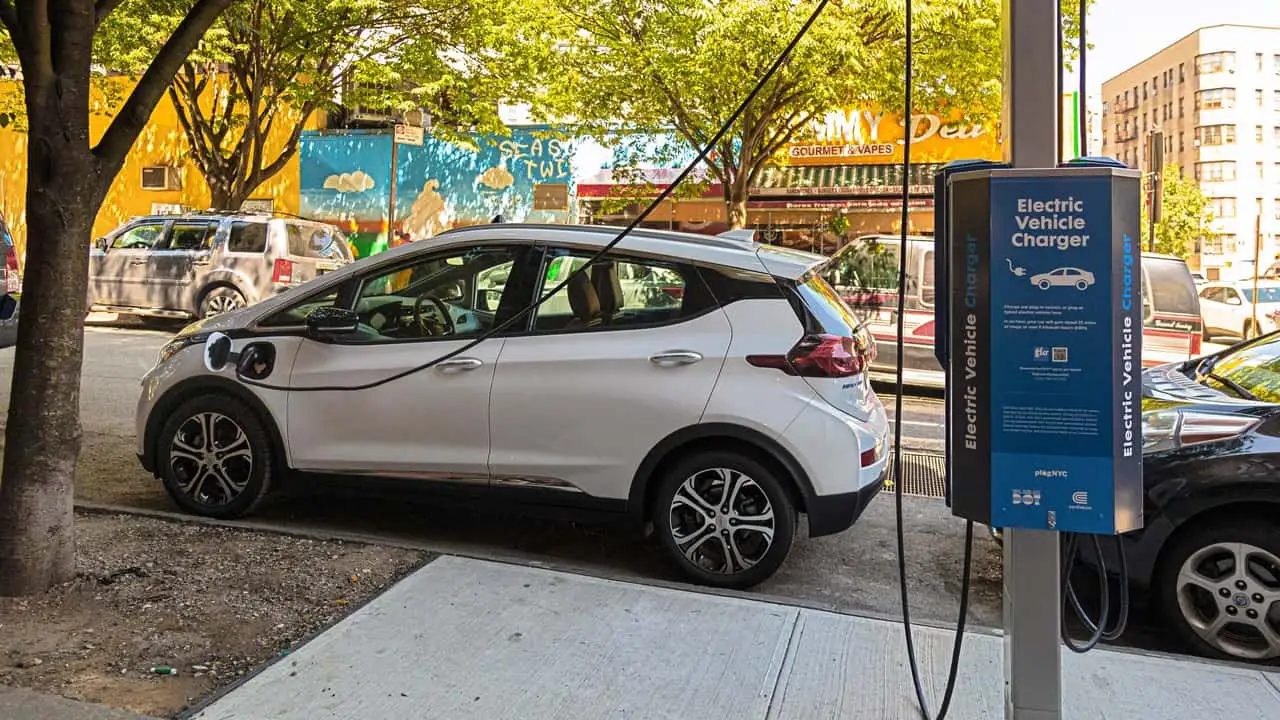
Instead of expecting every EV driver to find a private garage or a dedicated charging station, the city is putting chargers right along the curb.
It sounds obvious.
But in a city where millions of people park on the street, curbside charging could become one of the most important pieces of infrastructure for urban EV adoption.
Why curbside charging matters
Charging an electric car at home is usually the easiest option.
You park in your garage, plug in overnight and wake up with a charged vehicle.
But that model doesn’t work for everyone.
In dense cities such as New York, many residents:
- Live in apartments
- Park on the street
- Don’t have private garages
- Don’t have access to workplace charging
- May have to park several blocks from home
For these drivers, an EV can be considerably more complicated.
A petrol car doesn’t require a private parking space with a power outlet.
You simply drive to a fuel station when necessary.
EVs need a different infrastructure model.
That’s where curbside charging comes in.
New York has already started doing it
This isn’t just a proposal.
New York City already has publicly accessible curbside chargers.
The city’s Department of Transportation says it installed 88 Level 2 charging ports in partnership with Con Edison, while current project information shows the curbside network has expanded further.
As of March 2026, the city had 98 on-street Level 2 chargers deployed as part of its curbside charging program.
And the program is intended to grow substantially.
The city has been working toward a much larger network, including a previously announced plan to add 600 curbside chargers using federal funding.
The long-term ambition is even bigger.
New York has discussed a goal of approximately 10,000 curbside chargers by 2030.
That’s a significant change in how a major city thinks about EV infrastructure.
The charger essentially becomes part of the street
Traditional EV charging often happens in a dedicated parking lot or garage.
Curbside charging works differently.
A charging unit is installed next to an existing street parking space.
An EV parks alongside the curb, connects its cable and charges while parked.
In other words, the charging infrastructure is being integrated directly into the city’s existing transportation environment.
NYC describes its curbside chargers as Level 2 systems using the standard SAE J1772 connector, which is compatible with most EVs.
That makes the system particularly useful for cars that remain parked for relatively long periods.
These aren’t necessarily ultra-fast chargers
There’s an important distinction here.
Curbside charging isn’t primarily about achieving the fastest possible charging speed.
A Level 2 charger is much slower than the 150-kW, 300-kW or even megawatt charging systems we’re seeing in newer EV developments.
And that’s perfectly fine.
The purpose is different.
A driver might park the car for:
Two hours.
Four hours.
Six hours.
Overnight.
The car doesn’t need to charge at 500 kW if it is going to remain parked for several hours.
That’s the key idea behind urban charging
EV infrastructure doesn’t have to copy the petrol station model.
A petrol car needs a concentrated burst of energy.
An EV can take advantage of the fact that cars spend most of their lives parked.
That creates an opportunity.
Instead of asking:
Where can I find a giant fast charger?
The city can ask:
Where are cars already parked?
Then it can put charging infrastructure there.
That’s a fundamentally different approach.
The curb is valuable real estate
But there’s a problem.
New York City’s curbs are already extremely valuable.
They are used for:
- Parking
- Bus stops
- Loading zones
- Deliveries
- Bicycle infrastructure
- Pedestrian access
- Emergency services
- Waste collection
Adding EV chargers means competing with all of those uses.
That’s why curbside charging isn’t simply an engineering project.
It’s an urban-planning problem.
The city has to decide who gets the space
Imagine a street with limited curb space.
Should a parking space be used for:
A normal petrol car?
An EV charger?
A delivery truck?
A bus stop?
A bicycle lane?
A loading zone?
Every decision affects someone else.
As EV adoption increases, cities will increasingly have to decide how much public space should be dedicated to charging.
Curbside charging could be particularly important for low-income drivers
One of the most important arguments for public curbside charging is accessibility.
Home charging is easiest for people who own homes with garages or dedicated parking.
But renters often don’t have that option.
A public charging network can reduce that disadvantage.
New York’s curbside charging plans have specifically included attention to underserved communities. Earlier plans for the city’s 600 additional chargers called for more than half to be located in disadvantaged and low-income neighbourhoods.
That matters because EV adoption shouldn’t become something available only to people who can afford a house with a private charger.
The problem is bigger than New York
New York is an extreme example of urban density.
But the underlying problem exists in cities around the world.
Consider:
London.
Paris.
Lagos.
Nairobi.
Johannesburg.
Cairo.
In many urban areas, large numbers of people park their vehicles on public streets or in shared parking facilities.
If EV adoption accelerates, these cities will face the same question:
Where will all those vehicles charge?
This could be particularly important in Africa
Africa’s EV market is still much smaller than those of China, Europe or North America.
But the continent’s cities are growing rapidly.
That gives policymakers an opportunity.
Instead of waiting until millions of EVs are already on the roads and then trying to figure out where charging infrastructure should go, cities could begin planning now.
Curbside charging could be one part of that strategy.
Lagos presents a very different challenge
For a city such as Lagos, simply copying New York’s model wouldn’t necessarily work.
The infrastructure environment is different.
Electricity reliability, road design, parking behaviour, traffic congestion and informal commercial activity all need to be considered.
A charger installed at the side of a Lagos road has to deal with very different conditions from one installed in Manhattan.
But the underlying principle remains relevant:
Put charging infrastructure where vehicles already spend time.
Destination charging may be more useful than ultra-fast charging in cities
This is an important point for African EV planning.
The recent race toward 1,500-kW and even 2.4-MW charging is exciting.
But not every charging location needs that kind of power.
A shopping centre, hotel, office building or residential development may benefit more from moderate-speed charging.
Why?
Because the vehicle is already going to be there.
If someone spends three hours shopping, that’s three hours during which the car can charge.
If an employee works for eight hours, the car has eight hours to charge.
The same applies to apartments.
The best charger is often the one you don’t have to wait for
This is where charging infrastructure gets interesting.
A 350-kW charger is extremely powerful.
But if there is a queue of six cars waiting for it, the theoretical charging speed doesn’t matter as much.
A slower charger that is available immediately may sometimes be more useful.
That’s why cities need a mixture of charging options.
NYC is building both slow and fast charging
New York’s charging strategy isn’t limited to curbside Level 2 chargers.
The city is also expanding its fast-charging network.
In March 2026, the city announced the opening of additional EV fast-charging stations at municipal parking facilities.
The program is expected to provide 66 EVolve NY fast chargers across 10 NYC DOT municipal parking facilities in Queens, Brooklyn and the Bronx.
That creates a useful two-tier approach.
Curbside Level 2: charge while parked.
DC fast charging: charge quickly when you need to get back on the road.
Neither replaces the other.
The curbside charger is effectively an extension cord for the city
One way to think about this is that curbside charging brings electricity to places where vehicles already park.
It turns ordinary parking infrastructure into an energy network.
That could eventually become much more important as EV adoption grows.
Today’s curb is mostly a place to store cars.
Tomorrow’s curb could also be part of the city’s electricity infrastructure.
EV charging could change how we think about parking
This is one of the most interesting long-term consequences.
Today, parking is largely about storing vehicles.
With EVs, parking can also become an opportunity to transfer energy.
A car parked for several hours isn’t doing anything.
It could be charging.
That means the economic value of a parking space could change.
A space with an EV charger could potentially become more valuable than an ordinary parking space.
But that creates another problem
What happens if someone leaves their EV plugged in after it has finished charging?
The charger becomes occupied.
Another EV driver can’t use it.
This is known as charger blocking.
Cities therefore need rules to prevent charging spaces from becoming permanent parking spaces.
There may need to be:
- Time limits
- Charging fees
- Parking fees
- Idle fees
- Enforcement
- Digital monitoring
The charger has to serve as many drivers as possible.
The parking rules matter almost as much as the charger
A city could install thousands of chargers and still have an inefficient network if drivers misuse the spaces.
Imagine a street with four EV charging spaces.
If four vehicles remain parked there for 12 hours after charging is complete, the effective capacity of the charging station becomes extremely low.
That’s why successful curbside charging requires both infrastructure and regulation.
Con Edison is part of the equation
New York’s curbside charging expansion is being developed through partnerships involving the city, Con Edison and charging-network company FLO.
Con Edison says it is working with the City of New York and FLO to expand access to curbside charging across the five boroughs, including a program involving more than 100 charging ports.
That partnership is important because EV charging isn’t just a transportation issue.
It is also an electricity issue.
Utilities need to understand where charging demand will emerge and make sure the local grid can support it.
EV charging is becoming an energy-planning problem
As EV adoption increases, utilities will need to account for additional electricity demand.
But smart charging can help.
If vehicles charge at different times rather than all simultaneously, the grid can handle demand more efficiently.
Charging networks can potentially adjust charging rates based on electricity availability.
That could make EVs easier to integrate into the electricity system.
What about solar power?
Curbside charging doesn’t necessarily have to rely entirely on conventional grid electricity.
Some charging infrastructure can eventually be paired with renewable generation and battery storage.
For example:
Solar panels → battery storage → EV charger
could reduce pressure on the grid in certain locations.
The challenge is that solar generation isn’t always available when vehicles need charging.
That’s where batteries become useful.
The future could involve charging and energy storage together
This connects directly with the megawatt charging developments we’re seeing from companies such as Dongfeng and BYD.
At one end of the spectrum, you have extremely powerful fast chargers.
At the other, you have slower chargers designed to operate for hours.
Both can benefit from stationary battery storage.
A city could potentially use batteries to store electricity when demand is lower and then deliver it to vehicles when demand rises.
Curbside charging could help taxis and ride-hailing fleets
There’s another group that stands to benefit significantly: high-mileage drivers.
Taxi and ride-hailing vehicles travel much farther than ordinary private cars.
For them, charging isn’t an occasional inconvenience.
It’s part of the working day.
New York has been particularly focused on electrifying its for-hire vehicle sector, making accessible public charging increasingly important.
A driver who can’t charge at home needs reliable public infrastructure.
And a charger close to the street is far more convenient than having to drive to a distant charging station.
But commercial drivers need faster charging
Level 2 curbside charging may not be enough for vehicles operating almost continuously.
A taxi driver might need to recover hundreds of kilometres of range during a short break.
That’s where DC fast charging becomes more important.
Again, this reinforces the idea that a city needs different types of charging infrastructure for different users.
The real goal isn’t to build chargers
It is to build a charging network.
That’s an important distinction.
A collection of chargers isn’t necessarily a good charging network.
A good network needs:
- Geographic coverage
- Reliable equipment
- Easy payment
- Transparent pricing
- Adequate power
- Good uptime
- Clear parking rules
- Convenient locations
The customer shouldn’t have to think about any of that.
They should simply be able to find a charger and use it.
Reliability is crucial
Imagine an EV driver arriving at a charger with 5% battery.
The charger is broken.
That’s much more serious than arriving at a petrol station and discovering one pump isn’t working.
EV charging networks therefore need high reliability.
The more drivers depend on public charging, the more important uptime becomes.
Curbside charging also makes EVs more visible
There’s another benefit that isn’t discussed as often.
When chargers appear on ordinary streets, EV infrastructure becomes part of everyday life.
People see electric cars charging while walking around their neighbourhood.
They become familiar with the technology.
That can make EVs feel less like a futuristic product and more like a normal part of transportation.
Infrastructure can influence consumer behaviour
People are more likely to buy an EV when they believe charging will be convenient.
That creates a chicken-and-egg problem.
Consumers don’t want to buy EVs without chargers.
Companies don’t want to build chargers where there aren’t enough EVs.
Governments can help break that cycle by investing in initial infrastructure.
That’s essentially what cities such as New York are attempting.
New York is effectively preparing for more EVs
The city doesn’t need thousands of curbside chargers because every New Yorker already drives an EV.
It needs them because the number of EVs is expected to grow.
Infrastructure takes time to build.
Electrical connections take time.
Permits take time.
Construction takes time.
Planning ahead can therefore prevent charging infrastructure from becoming a bottleneck later.
The biggest challenge may be competition for curb space
EV charging is only one of many demands on the urban curb.
As cities become more crowded, that space becomes increasingly valuable.
The future could involve a much more dynamic curb.
A parking space might be:
A loading zone in the morning.
An EV charging space in the afternoon.
A parking space at night.
Technology could eventually allow cities to change how curb space is allocated depending on demand.
This is where smart cities come in
EV charging infrastructure could become part of a much broader digital system.
Sensors can monitor:
- Parking occupancy
- Charging status
- Electricity demand
- Traffic
- Charger availability
That information can be used to optimise the entire network.
Instead of treating chargers as isolated pieces of equipment, cities can treat them as connected infrastructure.
What New York gets right
The most important thing about New York’s approach isn’t necessarily the exact number of chargers.
It’s the recognition that not every EV owner has a driveway.
That sounds obvious.
But it is fundamental.
If EV adoption is going to reach apartment dwellers and people who rely on street parking, public charging has to be available where they live and park.
What cities in Africa can learn
African cities don’t need to copy New York exactly.
But they can learn from the principle.
Charging infrastructure should be built around how people actually use vehicles.
That could mean:
- Apartment charging
- Workplace charging
- Shopping-centre charging
- Hotel charging
- Fleet depots
- Highway fast chargers
- Public parking charging
- Carefully selected curbside charging
The infrastructure needs to match the city’s parking and electricity realities.
Lagos could eventually need its own model
For Lagos, a combination of destination charging, fleet charging and strategically located fast-charging hubs may make more sense initially than widespread curbside chargers.
But as EV ownership grows, curbside charging could eventually become useful in dense neighbourhoods where private parking is limited.
The important thing is to plan before demand becomes overwhelming.
GoGreenway’s verdict
New York City’s curbside EV charging experiment may look less exciting than a new 1,500-kW charger or a 1,000-kilometre-range electric car.
But in the long run, it could be more important.
Fast-charging technology solves one problem:
How quickly can I charge?
Curbside charging solves another:
Where can I charge?
And for millions of urban residents who don’t have garages or private parking, the second question may be the bigger obstacle.
New York already has dozens of curbside Level 2 charging ports, and the city is expanding the network as part of a much larger EV infrastructure strategy.
The city is also expanding faster DC charging at municipal parking facilities, showing that it isn’t relying on one type of charger to solve every problem.
That is probably the right approach.
The future of EV charging won’t be one giant charger on every corner.
It will be a network of different charging speeds in different places, designed around how people actually live.
And perhaps the most important charger of all won’t be the one at a futuristic highway station.
It could be the one right outside your apartment building.
Sources
- NYC Department of Transportation — official information on the city’s curbside Level 2 charging program and connector compatibility.
- NYC DOT Curbside Level 2 Expansion Program — current project information.
- Con Edison — information on its partnership with NYC and FLO to expand curbside charging.
- Rocky Mountain Institute — analysis of NYC’s curbside charging pilot and the barriers facing drivers without home charging.
- New York Power Authority / NYC Mayor’s Office — current information on the city’s fast-charging expansion.