For decades, filling up a car has meant pulling underneath a canopy, parking beside a pump and getting back on the road.
Electric vehicles are changing the technology behind that experience, but EVgo and General Motors believe the physical experience shouldn’t have to feel completely different.
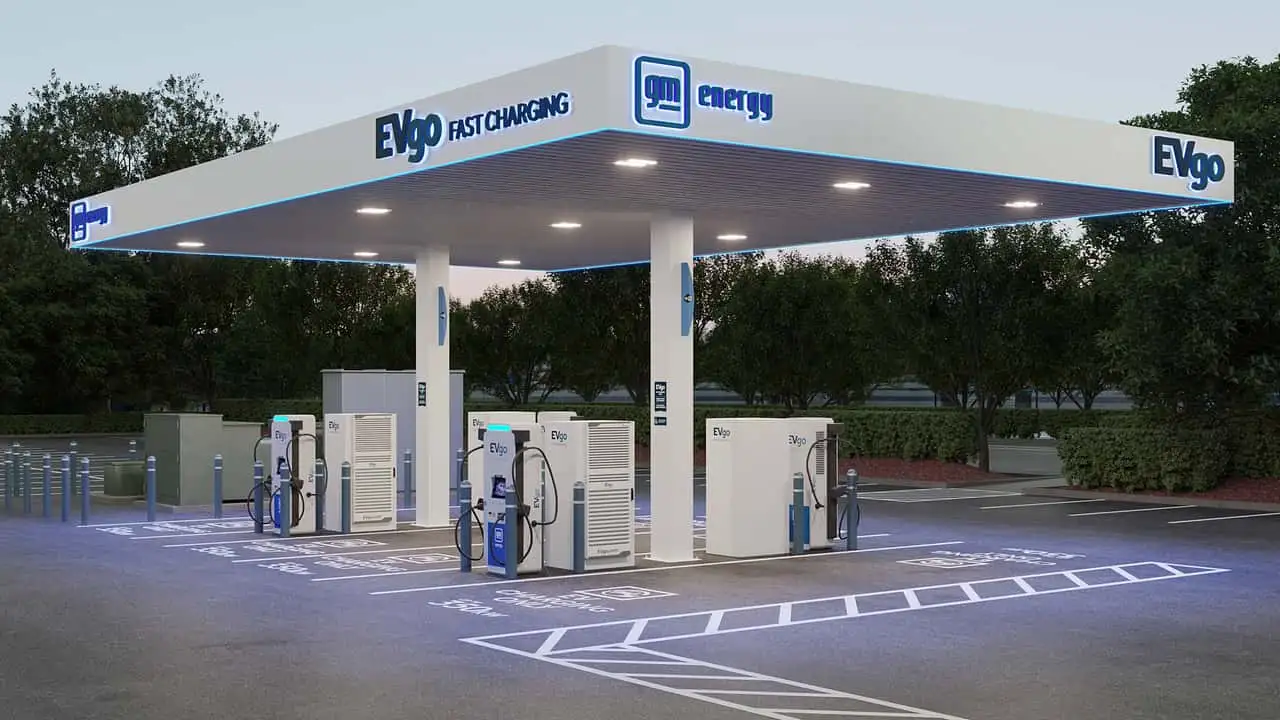
The two companies are developing a new generation of EV charging stations designed to look and feel much more like traditional gas stations.
And this isn’t just a concept anymore.
The latest EVgo flagship station opened in Warren, Michigan, in August 2026, featuring 12 fast-charging stalls, an overhead canopy, pull-through access and charging speeds of up to 350 kW.
The idea is simple:
Make charging an EV feel familiar, comfortable and convenient.
Why EV charging stations need to change
One of the biggest criticisms of public EV charging isn’t necessarily charging speed.
It’s the experience.
A petrol station is designed around one basic task: get energy into the vehicle and get the driver back on the road.
Many early EV charging stations weren’t designed with the same philosophy.
A charger might be tucked away in the corner of a shopping-centre car park.
There may be little lighting.
There may be no shelter from rain or extreme heat.
The charging cable might not reach comfortably.
And some charging spaces can be difficult to use if you’re towing a trailer.
EVgo and GM are trying to address these relatively mundane problems.
And they could be just as important as improving charging speed.
The new stations look deliberately familiar
The most obvious feature is the large overhead canopy.
If you saw the station from a distance, you could easily mistake it for a modern petrol station.
The canopy provides protection from the weather and makes the charging location much more visible.
The stations also use bright lighting and security cameras to make drivers feel more comfortable charging after dark.
That might sound like a small improvement.
It isn’t.
If EV drivers are expected to make long-distance trips, charging stations need to be places where people actually want to stop.
Pull-through charging is another major improvement
One of the smartest features is pull-through charging.
Instead of having to reverse into a charging space, drivers can pull in and then drive straight out.
That makes the station easier to use.
But it is especially useful for drivers towing trailers.
Imagine towing a boat, caravan or utility trailer with an EV.
At a conventional charging station, you may have to disconnect the trailer before you can position the vehicle correctly.
A pull-through charger eliminates much of that hassle.
EVgo says the Warren flagship was specifically designed with pull-through access to accommodate vehicles pulling trailers.
These are fast chargers, too
The stations aren’t sacrificing charging speed for comfort.
The Warren location has 350-kW charging capability.
EVgo says a full charge can take as little as 15 minutes, depending on the vehicle.
Of course, that doesn’t mean every EV will charge from empty to full in 15 minutes.
The actual charging time depends on the vehicle’s battery, charging curve, state of charge, battery temperature and maximum charging capability.
Still, 350 kW puts these chargers firmly in the high-power DC fast-charging category.
The newest station has 12 charging stalls
The Warren, Michigan, location includes a mixture of 12 CCS and NACS stalls.
That is important because charging networks increasingly need to accommodate different vehicle connectors.
The industry in North America is moving toward the NACS/J3400 connector, while many existing EVs still use CCS.
Providing both helps the station serve a wider range of vehicles.
EVgo wants larger charging locations
The Warren station isn’t intended to be a one-off.
EVgo says its flagship stations are designed to average up to 20 stalls per location.
The company currently has more than 40 flagship charging stalls operating nationwide and expects to have more than 100 flagship stalls online by the end of 2026.
That’s important because the future of EV charging isn’t simply about installing individual chargers.
It is about creating locations with enough capacity to handle demand.
Why bigger charging stations matter
Imagine arriving at a charging station with four chargers.
Three are occupied.
One is broken.
You now have a problem.
Larger charging locations reduce the chance that a single occupied or malfunctioning charger will leave drivers stranded.
They also allow more vehicles to charge simultaneously.
That becomes increasingly important as EV ownership grows.
EV charging is beginning to resemble a destination
Another major difference is the relationship between the charger and nearby businesses.
The flagship EVgo sites are located near amenities such as shopping, dining, grocery stores and other services.
That creates an interesting model.
Instead of building a charging station in the middle of nowhere, companies can place chargers where people already have reasons to stop.
The driver charges the car while doing something else.
The Warren station demonstrates this approach
The newest station is located at a Meijer retail location directly across from GM’s Global Technical Center.
That means drivers have access to shopping and other amenities while charging.
It’s a deliberate strategy.
The charging stop doesn’t have to be dead time.
It can become part of the driver’s normal trip.
This could be more important than charging speed
There is a tendency to focus on bigger numbers.
300 kW.
350 kW.
500 kW.
1,000 kW.
1,500 kW.
But an EV driver doesn’t necessarily care about the maximum number.
They care about the overall experience.
If a charger is fast but difficult to access, poorly lit and located somewhere uncomfortable, the experience isn’t great.
A slightly slower charger in a convenient, safe and well-designed location may actually be more useful.
EVgo and GM announced this concept in 2024
The partnership isn’t new.
In September 2024, GM and EVgo announced plans to develop 400 fast-charging stalls at flagship locations across major metropolitan areas in the United States.
The planned stations included 350-kW chargers, large canopies, lighting, security cameras, pull-through charging and nearby amenities.
At the time, the companies described the project as an attempt to establish a new standard for the public charging experience.
Two years later, those ideas are becoming physical locations.
The gas station comparison isn’t accidental
There is a reason the stations look familiar.
Petrol stations have spent decades solving the problem of moving people through a refuelling location efficiently.
They have:
- Large canopies
- Multiple pumps
- Clear entrances and exits
- Bright lighting
- Signs visible from the road
- Convenient locations
- Nearby shops
- Restrooms
- Food and drinks
EV charging companies can learn from that model.
The energy source is different.
The customer experience doesn’t have to be.
But EV charging has one major advantage
Unlike petrol cars, EVs can be charged almost anywhere the vehicle is parked.
You don’t necessarily need a dedicated refuelling trip.
You can charge:
- At home
- At work
- At a supermarket
- At a hotel
- At a shopping centre
- At a public car park
- At a highway charging station
That’s one of the fundamental differences between electric and petrol vehicles.
Public fast charging is still essential
However, home charging isn’t available to everyone.
Apartment residents may not have dedicated parking.
Renters may not be allowed to install chargers.
People travelling long distances need somewhere to recharge.
Commercial drivers may need multiple charging sessions during the day.
That’s why public charging remains critical.
The experience becomes especially important on road trips
Imagine driving several hundred kilometres in an EV.
Eventually you need to stop.
A good charging station should make that stop as painless as possible.
You want:
Easy entry.
Easy parking.
A charger that works.
Protection from the weather.
Good lighting.
Food or shopping nearby.
A quick charging session.
An easy exit.
That’s essentially what EVgo and GM are trying to create.
EVgo is also working with Pilot and Flying J
The companies are not limiting their efforts to urban flagship locations.
GM, EVgo and Pilot have also been developing a large highway charging network at Pilot and Flying J travel centres.
By March 2025, EVgo said chargers had been installed at more than 130 locations across more than 25 states as part of that program. The broader plan calls for up to 2,000 DC fast-charging stalls at as many as 500 Pilot and Flying J locations.
That is important because highway charging is one of the areas where the petrol-station model makes the most sense.
The future highway charging station could look familiar
Instead of:
EV → random charger in a parking lot
the experience could become:
Highway → charging plaza → canopy → charger → food → restroom → back on the road
That’s much closer to what drivers already understand.
But charging still takes longer than filling a petrol tank
Even with 350-kW chargers, EV charging isn’t identical to filling a petrol vehicle.
A petrol tank can generally be filled in a few minutes.
An EV might need 15–30 minutes depending on the vehicle and charging conditions.
That means the charging station has to make those minutes worthwhile.
This is why amenities matter.
Charging time becomes useful time
If you’re going to spend 15 minutes charging, you might as well:
- Buy coffee
- Get food
- Use the restroom
- Check your messages
- Walk around
- Shop for groceries
That is one reason EV charging and retail are increasingly being combined.
The charger brings customers to the business.
The business makes the charging stop more convenient.
Retailers have a reason to participate
A charging station can potentially bring people to a retail location who otherwise might never stop there.
Someone charging an EV may walk into the supermarket.
They may buy food.
They may get coffee.
They may shop while the vehicle charges.
That makes charging infrastructure more attractive to retailers.
It could create a new business model
In the petrol era, fuel was the primary reason people visited a filling station.
In the EV era, charging could become a way of bringing customers to other businesses.
The charging station becomes part of a larger destination.
That’s why shopping centres, supermarkets, restaurants and hotels are increasingly interested in EV charging.
Safety is another major consideration
EV charging can happen at any time of day.
A driver arriving at 2 a.m. wants to feel safe.
Bright lighting and security cameras can make a significant difference.
EVgo specifically includes enhanced lighting and security features in its flagship station design.
This is another area where the petrol-station model provides useful lessons.
EV charging needs to be visible
There’s also a psychological component.
If chargers are hidden behind a building, drivers may not know they exist.
A large canopy makes the station visible from the road.
That matters for people considering buying an EV.
When charging infrastructure becomes visible and familiar, electric vehicles feel more practical.
Infrastructure can influence EV adoption
There is a circular relationship here.
Consumers hesitate to buy EVs because they’re worried about charging.
Companies hesitate to build chargers because there aren’t enough EVs.
Governments and automakers can help break that cycle by investing in infrastructure before demand reaches its maximum.
GM and EVgo’s strategy is partly about doing exactly that.
What about charging reliability?
A beautiful charging station is useless if the charger doesn’t work.
Reliability may ultimately be one of the most important measures of a charging network.
Drivers need to know that when they arrive, the charger will:
- Be operational
- Communicate with the vehicle
- Deliver the promised power
- Accept payment
- Release the connector when finished
The industry has historically struggled with inconsistent charger reliability.
Improving the physical experience is only half the battle.
Bigger isn’t always better
There’s another caveat.
A giant charging station costs more to build.
It requires more electrical infrastructure.
It requires more land.
And it needs enough vehicles to keep the chargers busy.
That’s why EVgo is combining different approaches rather than building enormous stations everywhere.
Some locations can be small.
Others can become major charging hubs.
The charging network needs different types of locations
Think about it this way:
Home charging handles everyday use.
Workplace and destination charging handles parked vehicles.
Urban fast chargers handle people without home charging.
Highway charging hubs handle long-distance travel.
Flagship charging stations provide a premium, high-capacity experience.
There isn’t one solution for every driver.
What does this mean for Africa?
This is where the story becomes especially interesting for GoGreenway.
Africa’s EV charging infrastructure is still developing.
Many countries don’t yet have anything close to the charging density found in North America, Europe or China.
That means African markets have an opportunity to learn from the mistakes and successes of more mature markets.
The lesson from EVgo and GM is not simply:
“Build chargers that look like petrol stations.”
It’s:
“Design charging around the driver’s entire experience.”
Nigeria could benefit from this approach
For Nigeria, charging stations could potentially be integrated with:
- Shopping centres
- Supermarkets
- Restaurants
- Hotels
- Fuel stations
- Highway rest stops
- Fleet depots
A charging station doesn’t have to be a standalone piece of infrastructure.
It can be part of a destination.
Existing petrol stations could become EV charging hubs
This may be one of the easiest transitions for Africa.
Petrol stations already have:
- Prime roadside locations
- Entrances and exits
- Canopies
- Lighting
- Retail space
- Restrooms
- Customer parking
- Existing customer traffic
Instead of replacing them, some could evolve.
Imagine a future Nigerian filling station with:
Petrol pumps + EV fast chargers + convenience store + solar panels + battery storage.
That could serve both petrol and electric vehicles during the transition.
The transition won’t happen overnight
Petrol and diesel vehicles aren’t disappearing tomorrow.
For decades, filling stations will likely continue serving internal-combustion vehicles while EV charging infrastructure grows.
That means hybrid energy sites could make economic sense.
The station of the future may not be exclusively electric.
It may serve multiple forms of transportation.
EV charging could also create new opportunities for solar power
Nigeria has enormous solar potential.
Combining solar generation with battery storage and EV charging could potentially reduce dependence on the grid at some charging locations.
A simplified system could look like:
Solar → battery → EV charger
with the grid providing additional electricity when necessary.
That could be particularly useful for highway charging sites.
But fast charging requires serious electrical infrastructure
Just because solar panels are installed doesn’t mean they can instantly power a 350-kW charger.
High-power charging requires careful energy management.
This is where battery storage becomes important.
A stationary battery can store energy gradually and then provide high power to the vehicle during charging.
That can help reduce the instantaneous load on the grid.
The charging station is becoming an energy hub
This is perhaps the bigger trend behind the EVgo and GM story.
The future charging station isn’t necessarily just a place where you plug in.
It could become a combination of:
Transportation + retail + electricity + energy storage + digital services.
That makes charging infrastructure potentially much more valuable than a simple replacement for a petrol pump.
The customer experience could become a competitive advantage
As more companies build chargers, the hardware itself could become less distinctive.
A 350-kW charger from one company may not feel dramatically different from another 350-kW charger.
What could differentiate networks is everything around the charger.
Location.
Reliability.
Lighting.
Security.
Amenities.
Payment.
Ease of use.
Availability.
That’s why EVgo and GM’s approach is worth watching.
GoGreenway’s verdict
The most interesting part of EVgo and GM’s charging strategy isn’t that their stations look like petrol stations.
It’s why they look like petrol stations.
The companies are recognising that EV adoption isn’t only about battery range and charging speed.
It’s also about confidence and convenience.
Drivers want to know where they can charge.
They want stations that are easy to find.
They want enough chargers that they won’t be stuck in a queue.
They want protection from the weather.
They want good lighting.
They want somewhere to shop, eat or use the restroom.
And drivers towing trailers want to be able to pull through without disconnecting.
The latest EVgo flagship station in Warren, Michigan, brings many of those ideas together with 12 stalls, 350-kW charging, a large canopy, pull-through access and nearby retail amenities. EVgo says it now has more than 40 flagship stalls operational and expects to exceed 100 by the end of 2026.
That could be an important step in making EV charging feel less like a new technology and more like a normal part of everyday driving.
And for countries such as Nigeria, there is an even bigger lesson.
The best EV charging station may not be the one with the biggest charger.
It may be the one that combines reliable electricity, fast charging, good location, safety, retail and convenience into one place.
That’s exactly what petrol stations have been doing for generations.
The EV industry is now learning from them.
Sources
- EVgo — current flagship station program and August 2026 Warren, Michigan opening. EVgo’s official announcement
- General Motors — original 2024 announcement covering the 400-stall flagship charging program. GM’s official announcement
- InsideEVs — current update on the growing flagship network. InsideEVs coverage
- The Verge — background on the original GM/EVgo flagship charging concept. The Verge coverage
- Forbes — August 2026 report on the Warren flagship and how EV charging stations are evolving. Forbes coverage